
Topic starter
11/03/2008 7:58 pm
Greetings From New Orleans ,
Since my last posting a number of thoughts have also come to mind about the nature and different aspects of navigating ships and towboats in a high water environment . One element of this is: How do these large tows with any where from twenty to thirty plus barges manage to maneuver around some of the tight and swift turns we have on the lower Mississippi River . As was mentioned with the Str. Sprague , due to the size of her tows , much of the time she was going astern ( in reverse on her engine and paddlewheel ) inorder to maneuver and back around with limited technology and ability around these points anbd bends we have on the Lower Mississippi . As far as the modern day towboat is concerned , these boats now have a number of factors going for them that the Str. Sprague simply did not . First of all , the modern day towboat has anywhere from 5,000 t0 10,500 hp , two to three separate diesel engines and is equiped with flanking rudders which are located in front of the towboats propellers so that when the engines and propellers are going astern ( in reverse ) by maneuvering the flanking rudders from one direction to another the towboat is able to literally steer the stern of the vessel from one side to the other . Another tool the modern day towboat has are Flanking Buoys that are secured to the out side corners of the outside stern barges . The towboat pilots uses these buoys to literally determine his sternway or headway through the water . For example , when the Flanking Buoys are leading aft and are being pulled through the water , well obvisouly the towboat has head way or forward motion through the water . Then when the Flanking Buoys are leading forward and in front of the corners of the stern barges , well the towboat is going astern and has sternway through the water . Now when the Flanking Buoys are floating right off the corners of the stern barges , the towboat has neither headway or sternway and is literally going at what we refer to as current speed . When one of these large line towboats goes into a flanking maneuver around a point or into a landing , the towboat pilot will pay close attention to his Flanking Buoys so as to get an accurate idea as to what his vessel is doing in relation to his speed through the water . Ideally , the towboat pilot will slow the towboat to get down to Flanking Speed so as to literally move the Pivot Point of the tow from about one-third from the head of the tow to about one third from the stern of the tow , and thus almost become stationary in the water , so as to allow the current of the river to push around the head of his tow . This whole process can take up to thirty precious minutes to complete and when coming down on a large tow in a flanking maneuver and there is no room to pass around this flanking tow , it becomes very nerve raking .
Smoothe Sailing !
Ted Davisson
Topic starter
14/03/2008 5:00 pm
Flanking Buoys
Greetings From New Orleans ,
This is a shot of the M/V Julia Woods ( a former Mid South towboat ) south bound below Baton Rouge and approaching the Port Allen Lock forebay . If you look off the Julia Wood's stern and outside barge you will see the white Flanking Buoy that the towboat pilot will use to determine his speed through the water . Once again , if the Flanking Buoy is being pulled through the water then the towboat has forward motion or " headway " , if the Flanking Buoy is floating off the corner of the outside barge , then the towboat is down to current speed or " Flanking Speed ", and if the Flanking Buoy is forward of the outside barge then the towboat is going astern through the water and is backing her engines. In this day of literally high tech EVERYTHING , I for one think its just great that a simply buoy floating off the corner of a towboat will give more accurate and immediate information than the likes of any of the modern day gizmos ever will.
Smoothe Sailing !
Ted Davisson

14/03/2008 10:59 pm
Ted, it may interest you to know that flanking buoys were called "ear bobs" in the 1880's and later. They were usually a doubled-ended cone or pyramid and resembled a lady's dangling earring decoration. There is one in the Howard Museum collection. They were used in the same way as in your towboat picture.

23/03/2008 8:09 pm
I'm sorry, I just can't control my curiosity...
To all towboatmen, I understand why you need to flank the tow, and I've said on this forum that flanking was like watching 'a slow dance', it's truly poetry in motion. But I've been thinking that an awful lot of fuel is required to literially hold the tow in place while the turn progresses. Now, is there any possiblity to a secured remote controlled bowthruster, secured to the front of the tow, ala Mr Wally of Riverbarge fame, allowing the turn and continuous forward progress at the same time? After you all stop laughing, could you explain to me why that is a bad idea? I'm thinking a small, 300hp or so, digital radio controlled bowthruster may also be the insurance needed with those pesky tight pucker factor spaces...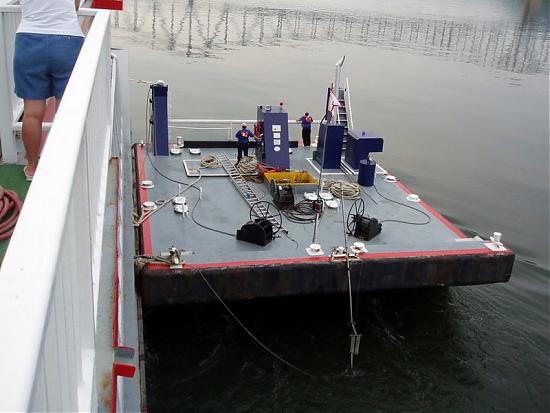
23/03/2008 10:13 pm
This is a good question, Bruno. I will try my best to address each of your questions, and I welcome others to jump in as well.
First, the flank maneuver takes only 10 to 15 minutes at most. The higher and swifter the water, the quicker it can go, but there is also more danger involved. There is a greater usage of fuel at the first part of the flanking maneuver, but then very little is used....a pilot first anticipates he will need to flank a bend, so he/she starts by slowing down a couple of miles before getting to the bend. At the point where he needs to start getting her in shape and flanking, he backs pretty hard to get the tow down to current speed, or maybe a little less than current speed, and gets his stern where he wants it to be. At this point, he may "shut 'em off" or knock his engines out of gear and just float for a while, while the current gets him where he wants to be. He might have to knuckle one or both engines in gear for a minute or so while this goes on, but nothing drastic. The head is down in the swifter current, and comes around because it is in the bend, and the stern is still holding kind of above the bend in the straightaway. When the turn is almost finished and the tow is setting where he wants it, it is time to come ahead....you can over-flank with as disastrous results as if you did not flank at all. Setting up for your flank and knowing when to "go" at the lower end is where the piloting comes in....anybody can steer a boat or a tow up or down the river. It is this knowledge gained from experience and good teaching that tells a pilot when and just how to do all this in any given situation.
Why not just have a remote controlled bow thruster? Another good question. Many have tried this, with limited success. First, it does not eliminate the need to flank. A bow thruster, whether built in to the hull of a boat/ship, or lashed on the head of a tow, is only effective when either stopped or at very low speed (headway or sternway), maybe 2 or 3 mph. Most flanks are done at about that speed anyway. If one tried to steer down in a bend at 12 mph and used a bow thruster, the tow would still "slide out" of the turn and get 'way down in the bend. Cargo Carriers Corp. (a division of Cargill Grain) tried bow thrusters on their big lower Miss. boats a number of years ago, and I assume they discontinued this because they were not worth the trouble, and did not elimintae the need to flank. A number of other companies have used bow thrusters on tows, too, again with limited success. The bow unit tends to get in the way, for one thing. If a tow is operating on a locking river, having the thruster in tow reduces tow size...that's 1,500 tons of cargo the boat can't push. For the little time it is used, it does not make economic sense. There are two scenarios where this MIGHT not apply: the Gulf Intracoastal Waterway and the Illinois River. Both of these waterways are narrow and shallow. When a boat has a tow of empty barges and the wind blows so hard that they can't "hold 'em up" in the wind, the empty tows get windbound, sometime for a day or three. In this case, a bow thruster can be helpful in getting them "picked back up" in the wind and to help at locks, etc. Again, you have the extra piece there (the bow thruster unit) and there is maintenance on the unit, too, which is a headache.
I hope this answers your questions!
24/03/2008 12:00 am
Thanks a lot, Bob. You did indeed answer my questions. Interesting, I never knew the thruster loses effectiveness at speed...makes sense when you think about it...
However, when I think of flanking, I think of New Madrid. There flanking the whole bend takes more than 15 minutes right? Or was I so enthralled with watching the manuever that "it seemed like hours"... 🙂
24/03/2008 12:12 am
You're welcome!
When you mention New Madrid, are you referring to a flank maneuver you actually witnessed there, or are you looking at a map and imagining the entire bend must be flanked from Winchester Towhead to Shields Bar? The whole bend is really a fairly gentle one, easily steered at any stage. At low water, a flank might be in order at a couple of places in there (foot of New Madrid Island, for instance) where the channel would be extremely narrow and swift. This is, however, rare. While there are certain places you could not meet in that big ol' bend, it is easily steered.
24/03/2008 1:16 am
No, I'm definitely thinking of New Madrid...for reference, Deb and I have been in New Madrid once, September 3, 2003...
Maybe what I was observing wasn't a flanking manuever? With me standing in New Madrid, looking south at the river, I remember the tows going left to right (East to West, Upbound, correct?) and the boats took a LONG time to get through there. The boats were for the most part not really moving forward, just turning, moving side to side is all, the whole "stick" pivoting, then there would be a very short visual and aural increase in speed, say for a few minutes, the engines would back off again and the non-movement would start again. To get all the way around took well over an hour, or so it seem with me trying to predict what would happen, love that stuff.
Now I preface this with the fact that I can barely remember what I just had for dinner... 🙂
24/03/2008 1:31 am
You got me, Bruno! It could have been a number of things....picking up/dropping a barge? Even though downbound traffic has the right of way, sometimes downbounders will hold up for an upbounder who is (a) moving very slowly (b) shoved up in a tight place on a downbounder. Right there at the head of New Madrid Island (the city front) is not a flank job at any time. Can't say what might have been going on!
24/03/2008 1:34 pm
Bruno, flanking is nearly always, if not always, a downstream maneuver.
25/03/2008 12:24 am
Yes, Capt, you're right, it could have been tows heading downstream that I saw doing the dance.
I make NO guarantee to the accuracy of my feeble memory...