
Topic starter
23/03/2008 7:34 pm
I've been studying older postcards, older pictures of the Delta Queen to try and grasp the time line by what I see in the pictures. These four pictures interest me in the unique use of color at the aft end of the boat. Could somebody here point me to the correct years for these pictures if my guesses are wrong? Thanks!
The first two pictures are basically the same time period? Pre-calliope, natural material wheel, WHITE ! signboard...I'm thinking mid 1950's...say 1956?
It was about this time, 1958, that I visited the DQ as a youngster. And I vividly remember the wheel not being red...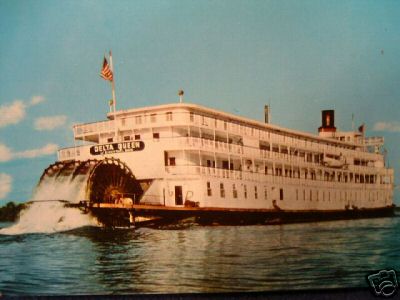
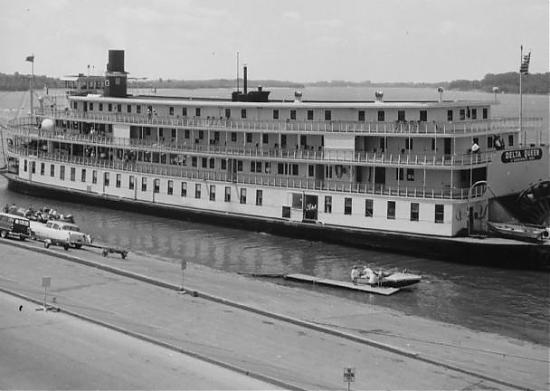
Topic starter
23/03/2008 7:45 pm
Now these next two are a bit of a surprise to me. The first with a black (black, really?) splashboard, but with a hint of a calliope showing? I'm sorry the picture resolution is so bad, it's from a postcard, maybe somebody has the postcard...I'm thinking 1960, the first calliope year...
The second picture below looks really recent but my guess is 1961 or '62, and the discovery of the right shade of red paint was a stroke of genius. Notice no dual portholes in the splashboard, simplier script on the signboard, no calliope fru-fru, still white doors and windows...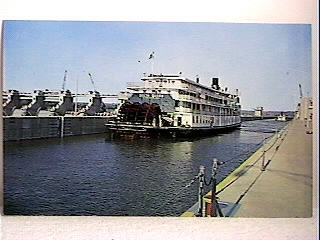


23/03/2008 9:33 pm
Bruno and Steamboat Buds,
As I have suggested before, it would be both interesting and beneficial to compile a series of DELTA QUEEN photos, prints, etc., in chronological order, that would document the boat as she looked year by year after coming up the Mississippi after her epic journey from the west coast and into the present. Some of our California friends might want to do the same for the Golden State years.
23/03/2008 10:46 pm
Good idea, Sam.
Bruno, as to your questions, I will venture a guess on only one, due to my limited knowledge compared with others on this board: The last one is at Memphis, my home town. I can fairly well date it by the surroundings I see, and I would place the year from 1969 to 1971.
I am thinking the black splashboard may have been a Capt. Wagner thing...I wish Doc was on here so he could tell us for sure. There is a well-circulated picture of the DQ tied up at Lambert Landing, St. Paul, with the black splashboard, and for some reason I'm thinking that was right after Doc & Cap went over there.

23/03/2008 11:19 pm
Bruno,
That looks like a 1955 or '56 Cadillac there on the landing. And the landing itself looks like St Louis or the old Memphis downtown landing we used to use.
Paul
Topic starter
23/03/2008 11:50 pm
Bob, thanks for your input on the last picture. I'm still not sure about '69 to '71 because didn't the dual port hole (Texas deck) windows in a brand new splashboard, a spashboard with integral script writing around those two portholes appear in 1968? That new splashboard is in the famous picture with the blue '72 Nova which we all know was shot in summer '71. I think the calliope backdrop was up by 1968, too. But I'm not positive...
You know I also remember a picture of the DQ posted here a while back...Marietta landing, with a black spashboard, or am I all wet here. I think everybody had trouble dating that one too.
Gawd, I love this stuff...Show of hands for Sam's idea, you betcha...
23/03/2008 11:52 pm
Good sleuthing on the Caddy, Paul, but that landing is Evansville, IN.
23/03/2008 11:58 pm
Bruno, the calliope frou-frou, splashboard portholes with new lettering, etc. was 1970 at the earliest; I'm thinking '71. Shipyard Sam and/or Jim Blum can set us straight for sure...
24/03/2008 12:59 am
Bob Reynolds;10150 wrote: Good sleuthing on the Caddy, Paul, but that landing is Evansville, IN.
You mean there are more steep, cobblestone landings than STL and MEM?
Sheesh!
:O)
Paul

24/03/2008 2:01 am
My guesses...picture 1....1957, notice the smoke stack base was red, white and blue, a Paul Underwood idea; picture 2 ......1956, definetly taken at Evansville; picture 3 .....1960 and by the way the splash board was not black, it was Greene Line green; picture 4 ....1962/3. Those are guesses. Like Dale says, what do I know.
Question..what year were the wing bridges moved from being behind the pilothouse to coming out the side of the pilot house? (mid 60's ????) In all these pictures it looks like the wing bridges were still behind the pilot house.
Topic starter
24/03/2008 2:13 am
Jim, Bob and Paul, many thanks...
And just to add a bit...The picture below shows what Jim pointed out, that the splashboards were green at one time not black as I assumed, you just gotta find a color picture, don't you just love eBay? Franz, I hope I'm not treading on any trademarks here, am I?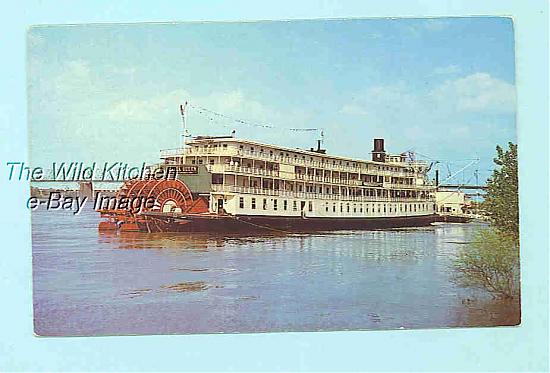
24/03/2008 2:32 am
Now, Jim, I don't want to argue, but in picture #4, it appears to me that the wing bridges are coming out from the pilothouse and that the port side pilothouse door is open. Also, the 100 North Main building is seen in this photo, and that building was not completed until 1966, at the very earliest. The Waterways Marine towboat LAURA B. is in that photo as well; she was built in '67, so that is the absolute EARLIEST it could be...but 1970 or 71 is my story and I'm sticking with it!
24/03/2008 4:07 am
Bob....couldn't get these trifocals focused in on that small picture but I stand corrected upon closer inspection. Like I said I was making some educated guesses. I think the Big E changed the wing bridges shortly after he took command of the boat. The low back pilot house door would be a real squeeze for him.
There has been a lot of discussion about the color of the splashboard, but I've seen it white, green and red. There is just no "natural" color. Underwood didn't like red he said red made boats look like circus wagons. Tom Greene painted it white originally. I don't know who painted it red in the first place. My preference is white.

24/03/2008 12:29 pm
Bruno,
You have unearthed an interesting picture taken at Louisville, KY. I would guestimate it is about the time of the first DQ/BoL race, as you can clearly see the stern of the RENOWN (the BELLE's former wharfboat) and the BELLE appears to be tied in across her bow (as they only did prior to the new concrete landing). You can justr barely see the BELLE's stacks above the wharfboat.
All that said, I think it MAY be prior to the first race on the 30th of April 1963. Which would ring true with the statements made by others alledging the black sprayboard was in the early Capt. Wagner/Capt. Clarke C. "Doc" Hawley days. It could also be the 1964 race, as the water appears to be up quite a bit (note the willer in the water on the bottom right), and I hope Capt. Alan Bates will jump in and clear this date up as he was Mate on the BELLE at the time and should know.
The dual portholes, calliope circus gingerbread, and una-fon (second, lower keyboard on her calliope. It was essentially a xylophone played by a keyboard with two settings for the hammers; single tap and reiterating), all showed up when she was saved in 1971 and were not on her before.
According to a story related to me by the late Pat Sullivan, Arthur Davis (Seattle, WA. builder of the MISSISSIPPI QUEEN calliope) and Cmdr. E.J. Quinby came up with the Una-Fon idea (it was sourced from the collection of Slim Sommers from whom the DELTA QUEEN calliope came in 1959) and it only lasted aboard the boat till the early 80's and rarely played correctly the whole time. I only remember playing it once in 1978. Even then only about 3/4ths of it worked. I was told it was wired for indoor operation, hence all the problems. Originally the una-fon was mounted on the roof in two boxes in a diaphonic (every other note for those not pipe organ saavy) arraingement. The "C" side was the port and the "C#" sid was starboard. Later the una-fon bells were mounted on the deck abreast of the calliope keyboard with the sides remaining the same.
For the wing bridges, all evidence points to 1968 from the dated pictures I have here on the laptop out on the river. When I get home, I will see about researching this further.
However, I am just a calliope player...what do I know (thanks Dale, I love that line!)?
~Travis~
24/03/2008 1:20 pm
The new splashboard was installed after the DELTA QUEEN was saved at the last moment. When we returned to the boat in the early months of 1971, the splashboard with the cute round portholes replaced the old one that was in a pretty bad condition.

24/03/2008 1:28 pm
Travis,
I cannot pinpoint a date beyond 1963-1966. As everyone 0n this board knows mating distracts a man. It is definite that I-64 was not even started, which happened in late 1969-70.
24/03/2008 2:12 pm
I think you may have pinpointed the date, it was either 1964 or 1965. What year did ACBL give the RENOWN to the BELLE? Perhaps Bill Judd would know becuase ACBL got the RENOWN when it bought out Island Creek. ACBL had Jeffboat paint the RENOWN and reskin the hull, then gave it to the City for a tax write-off.
24/03/2008 4:33 pm
I certainly agree with your opinion, and that of Captain Tom Greene, Jim. White paint would look so much better than that awful red and yellow! Good taste doesn't count any more it seems, as we've also learned from what they did to the AQ by adding the Majestic blue paint. Now what kind of color scheme do you suppose they will dream up for the MQ!

24/03/2008 6:23 pm
I just browsed through a few of the old Greene Line Steamers' brochures and found some more interesting details about colors used on the boat over the years.
First of all some more details about the splashboard: The 1967 brochure on one photo shows the splashboard being painted in red, but the name board still black with white letters. Another photo right opposite on the same page as the first one, shows the splashboard still being paintes completely black. From that I assume that the change from black to red probably happened in 1966.
A 1972 brochure shows the splashboard in red and the nameboard much larger than before and with yellow ornaments.
In the 1955 Greene Line Steamers, Inc. brochure (the earliest I have), the smokestack framing is painted red-white-red with a big black or dark-green "G" in the white area. The same picture is still appears in the 1965 brochure. In the 1965 brochure there is an additional picture showing the jackstaff, boom and the search lights being painted in yellow (!). Deck is painted grey in this picture.
Better not talk about the interior of the boat in these times! A photo in the 1965 brochure for example shows the mahogany wood of the grand staircase painted in a shade of mint, amongst other cruelties.
As Jim said: There is no "natural" color. Things have changed again and again over the time, sometimes it turned to good, sometimes to not so good 😉
24/03/2008 7:13 pm
Credit Capt. Wagner
The interior of the DQ was painted a "mint green" until, believe it or not, when the DQ was in Avondale shipyard in the Spring of1971. Anyone on here who does not harken back to those halcyon years may well be shocked to learn that all the California grained Golden Oak in the Forward cabin lounge, the Grand Staircase with cast brass filigree, the many Philippine mahogany stanchions, and even those lovely, little stained glass windows were painted. The brass and the stanchions were doped a smokestack black; the rest mint.
Full credit goes to Captain Ernest E. Wagner who started uncovering what is now taken for granted as a splendid example of possibly the loveliest wood and brass interior cabin ever assembled on a steamboat. The painting was done in earlier years when "natural" woods were considered too dark and out of style, and the liberal application of paint also cut down on the maintenance and upkeep associated with maintaining "bright work". So it was done without malice.
Each year, Big Cap uncovered more and more of the interior, and possibly Gabe, Jim, and others, continued what Captain Wagner started until the mint was opsayo. That green mint still holds a special place in my memory as the way the DELTA QUEEN looked when I first started hanging around; so I expect to have a splash of the color on my own boat as a tribute to times gone by.
A "Greene G" is already in place on the forward end of the second deck.
24/03/2008 8:39 pm
The Renown probably arrived in 1965.
24/03/2008 10:49 pm
Sam, this was the color scheme the very first time I set foot on the boat, about age 9 or 10. The floors in the lounges were a checkerboard pattern of asphalt or some other tile, 12 inches square, alternating green and grey. I remember my mother aying she was not overly impressed!
As for the red splashboard, I rather like it, but you all know what they say about opinions!
One more question (which may have been answered here before): when was the "little steamship" streamlined stack replaced with the one that the QUEEN wore until just a few years ago?
25/03/2008 12:08 am
The exterior handrails shed their lime/mint/whatever green in 1979. Some of the cabin deck room shutters were brought back to natural wood during that same period. One good, but maybe not so good thing done during the 70-71 layup was that the bronze work in the grand staircase was sandblasted. While it certainly removed the "gold" paint it also removed the polished surface of the bar stock scrollwork.
25/03/2008 12:13 am
Capt. Jim, are you sure you didn't mean to say 1979 about the exterior handrails? I know they were always dark from the time I started working on the boat in '75, though that first year they were not varnished...we oiled them with tung oil every week or so. Certainly no paint on them.....
25/03/2008 1:07 am
Yes, the exterior handrails. Didn't think it was as early as 1975. Another question for Photo's to help answer
Page 1 / 2
Next