Topic starter
08/04/2009 2:17 pm
Hello,
I am new to this forum and am looking for info on how the valves were operated on the large stroke engines of sternwheelers. I am familiar with steam locomotive valves of different types, but am confused about sternwheelers. I see the pitman arms and cranks on the stern wheels but I don't see any eccentrics or eccentric rods next to them. How were the valves operated?
If anyone has any pictures of any of these valve operating methods they would be appreciated.
Thanks, Jeff

08/04/2009 4:36 pm
Hi, Jeff, and welcome to the board!
I am not really the person you need, as my knowledge is VERY limited. However, some boats (the DELTA QUEEN is one) do have eccentrics on the wheel hub that operate the valve gear. There are several (maybe only 3 or 4) systems for operating the valves and cut-offs on western river style boats, varying according to when the engines were built and by whom.
You need to get Alan Bates' books "The Western Rivers Steamboat Cyclopedium", and the "Engine Room Cyclopedium". Very well written, and maybe more information than you want.
Topic starter
08/04/2009 5:29 pm
Thanks for the info Bob.
Anyone have info on the western boats Bob mentioned?
Thanks Jeff Dayman

08/04/2009 7:30 pm
Jeff Dayman;16513 wrote: Thanks for the info Bob.
Anyone have info on the western boats Bob mentioned?
Thanks Jeff Dayman
Jeff, I'll be heading home and working on my vessel the Chautauqua Belle this weekend, I'll take some pictures of our Stephenson Valve gearing that controls our paddlewheel if you would like?
08/04/2009 9:14 pm
Jeff,
In the Western Rivers Engineroom Cyclopoedium, the author Capt. Alan Bates mentions two valve gears adapted from steam locomotives. One is the Stephenson gear mentioned in another thread on the CHAUTAUQUA BELLE. The other is a variation on the Walschaert gear. These are fairly uncommon on boats, however. The DELTA QUEEN uses eccentrics mounted toward the end of the wheel shaft inboard of the cranks and connected by frames that reach back into the engine room to operate the valves. The DQ also has a California Cutoff to regulate the admission of steam to the cylinders and cut it off at almost any point in the stroke. The eccentrics and reach frames are easily seen on board the boat and easy to watch from the second deck stern as she operates.
I don't know where you are located, but here is how you can obtain Capt. Bates' wonderful books:
The Western Rivers Engineroom Cyclopoedium
The Western Rivers Steamboat Cyclopoedium
I believe they are available at the Howard Steamboat Museum in Jeffersonville, IN, but are certainly available from the author & publisher:
Cyclopoedium Press
2040 Sherwood Ave.
Louisville, KY 40205-1112
The author, Alan Bates, is a poster to this board, and the author of several books about steamboats and the rivers. He ain't written one yet that I cannot recommend highly. You are new to the steamboats.org board. I urge you, if you haven't already to consider becoming a member of The Sons & Daughters of Pioneer Rivermen. See the link here: The Official Website of Sons and Daughters of Pioneer Rivermen

08/04/2009 9:30 pm
Jeff,
On the Natchez, our steamboat in New Orleans, we use the Walschaert gear Bob was talking about. I don't have any really good pictures, but you might be able to see a little bit in these two.

08/04/2009 9:46 pm
Matt will prob recognized this photo, another one of his vessels the Minne-Ha-Ha and it's Stevenson gearing
Also here is a nice website showing gearing on steamboats I ran into the other day. steamboat engine

08/04/2009 10:42 pm
Valve Motion
On any steam engine, two motions are needed. A motion 90 degrees different from the crank motion, and the crank motion. The first motion is the primary valve motion, and the second motion triggers cutoff, or steam shut off at partial stroke. On many steamboats, a rough equivalent to the 90 degree motion can be taken from the rise and fall of the pitman arm.
However, this motion is elliptical, not circular, and thus introduces some irregularity in the valve motion. On a traditional steamboat, this does not matter, because this motion is the "full stroke" motion and the valves are designed to either be on or off. The cutoff motion is taken from the crosshead.
Stephenson valve gear is really not appropriate for a paddle steamer. Note that stephenson valve gear requires a curved link. When fitted with a straight link, the valve motions are corrupted and cutoff positions are not correct. A straight link limits correct valve events to full stroke forward or reverse. Stephenson valve gear has variable lead, which means as cutoff is introduced, the valve events are advanced relative to the stroke, similar to an auto distributor advance. This is desirable as speed increases to facilitate steam movement in the passages and cushion the end of stroke. However, sternwheelers do not attain the speeds necessary to benefit from advance lead. The advance will instead rob the engines of power.
The best valve gear will differ between high speed engines (locomotives), compound engines (Delta Queen, Natchez), and slow single expansion engines. Slow speed, long stroke, single expansion paddle wheel engines need a fixed lead and variable cutoff. This is ideally provided by California cutoff (Disney engines, Lone Star), Rees cutoff (Belle of Louisville), or separate eccentrics for full stroke and cutoff (Arabia).
Topic starter
20/04/2009 6:33 pm
Thanks to all who replied, it is a wealth of information.
Best regards, Jeff Dayman
20/04/2009 6:51 pm
You're quite welcome. This is the best place for that kind of information, and "people on the river are happy to give!" Here's something else that might interest you. I found this video while surfing Youtube, and it does a really good job showing the linkage on the Natchez in motion. Enjoy!
YouTube - Natchez Starboard Steam Engine

20/04/2009 8:44 pm
You can no longer get these books from Alan, directly, but look up the Howard Steamboat Museum on the internet and get their phone number. You have to call in the order. Old steamboat valve gear could vary quite a bit. The DQ has Stephenson linkage as does our little steamboat, the Graceful Ghost. It is not so complicated so that dummies like me can get it. I guess I will never understand the valve gear on the Belle of Louisville, even if I could watch it all....day....long.......
20/04/2009 10:12 pm
I believe the DQ has California cutoff, like the Disney boats. This is visible in videos of the engine on Youtube. The DQ does have two eccentrics, for backing and forward, but the cutoff is controlled by a pendulum on the crosshead.

21/04/2009 1:38 am
Jeff,
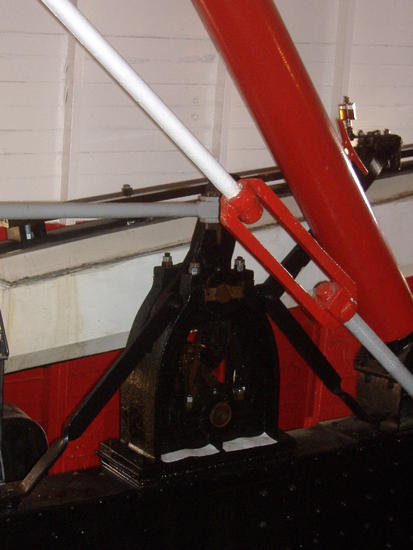
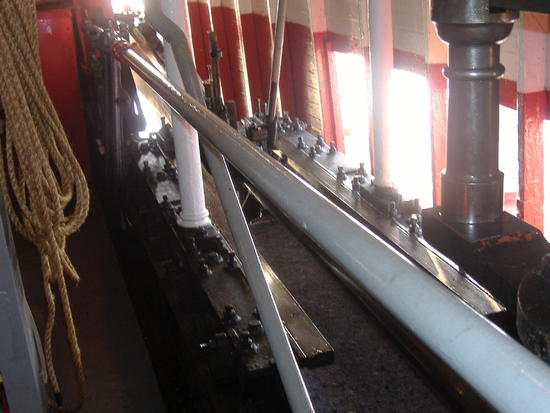
On the Belle of Louisville we have a valve gear, I believe, was patented by the company who built the her--James Reese & Sons. From what I understand, Reese's innovation was to move the eccentric inside, instead of going out the the shaft, like the Delta Queen. This placement inside, of course, makes it much safer and easier to maintain (and I am forever grateful for staying dry). However, some engineers, I've been told, did not consider this design to be a true eccentric. Ours has worked well for over a hundred years, so you'll get no complaints from this quarter. Despite the forgiveness these engines have shown over their long life, we discovered just how sensitive they are to any slight adjustments when we reset the timing a few years ago, especially when your ears are tuned to hundreds of hours of the same rhythm. If I can dig up any decent photos of 'em, I'll try to get them posted.
10/05/2009 7:04 pm
Sternwheeler Valve Gear
Jeff,
I apologize for the slow response as I said I would find some pictures of the Belle's cam assembly. The first photo shows the aft end of the assembly (stbd. side) as the motion of the pitman (in the background) is transferred from the slide to the cam "lobe" on the engine timber (the black color makes this a little difficult to see). From the cam lobe to the upper end (we've called the "crow's foot"), the motion is transferred to the grey rod running a few feet above the timber. The next shot shows this rod (port side) with the aft assembly in the background. The last shot shows where the rod attaches to the engine (stbd.). This is where our ship-up jack can move this rod into the forward or reverse position. The rod's motion will then tranfer to a set of "wipers" that, ultimately, opens and closes the intake and exhaust valves. Let me know if that made any sense, as I condensed that down. I always like to tell people it is better to understand this once it is in motion. I hope this helps, if it isn't too late.