Topic starter
17/04/2011 4:01 pm
I was wondering - how do steamboats generate their power. I guess it is from the steam engine, but how? And when the "coals are dropped" how is power supplied.

17/04/2011 10:02 pm
They had/have a generator just like the one you can buy at Lowe's, except a steam engine supplies the power. This is a separate engine from the main propulsion engine. Often it is a steam turbine. Of course, the generator is a much larger one than what you'd buy at Lowe's for emergency power. Old-timers called it a "light plant".
When the main boilers are cooled down on a steamboat, there are several ways to keep power and/or steam. The old-time boats had "donkey boilers" or "n*gger boilers", as they were sometimes referred to. They would be fired up just to generate steam for lighting, heat, and other auxiliaries. Later on a gas or diesel generator might be used. There is always shore power for longer down times. Way back, they'd just cool down and not have anything else running until they could get the main boliers back online.
Topic starter
19/04/2011 9:04 pm
Steam Turbine
Boy I would sure like to see a photo of one of those steam turbines. Sure it
is quite different from steam turbines today.

20/04/2011 12:51 pm
Take a trip on the Belle of Louisville, I don't have my external HD here with my pictures, but I'm sure someone on here has some they can post. Even though they don't use it anymore, it's a fine looking piece of equipment.
Aboard the Chautauqua Belle we have a Troy-Skinner unaflow steam engine, which is about the same efficiency as a single stage turbine engine, which turns the generator.
On the Empire State IV (which is one of the last ships to still use steam and soon to be gone), we generate power using 2 General Electric Ship Service Steam Turbo generators, each one is 750 kW. They use the exhaust steam/auxiliary steam from the turbine used for propulsion, which is a Newport News geared turbine, cross-compounded; the high-pressure turbine is impulse type blading, 39 nozzles, 9 stages and the low pressure turbines is impulse/reaction type balding, astern element. That turbine comes in at between 17,000 to 19,000 HP.
From the smallest plants to the largest one, the generator itself of the system is the same in regards to how it looks and works, the only thing that ever really "changes" is the mechanical means you make it spin by (the engine attached to the unit).
21/04/2011 11:44 am
A steam dynamo appears in the lower-right foreground of this photo. It is the engine room of the steam towboat Capt. Alphin. The photographer was standing nearly all the way aft, on the port side, looking forward.
22/04/2011 7:29 pm
Steve Huffman;25596 wrote: A steam dynamo appears in the lower-right foreground of this photo. It is the engine room of the steam towboat Capt. Alphin. The photographer was standing nearly all the way aft, on the port side, looking forward.
Haha Steve wouldn't you know, thats a Troy-Skinner engine.

23/04/2011 3:29 pm
Yes, the turbine you see in Matt's pic just passed inspection for another season--ran it for a few hours without a hitch! It doesn't run much these days, which can make it difficult to get a consistent operation from it--like any steam equipment that doesn't run often. When I started on the Belle, the Chief I worked under liked running that turbine, which was during the evening trips when we would draw our largest electrical load. It was much quieter than our more modern diesel generator, but I had to fire our boiler much harder to make steam for it! It had a twin on the other side we would run during the day trips. I have many memories of coming on watch as our crew were "winding down" the turbine from the day trip--made for a much warmer engine room! It also reminds me of the American Queen's first time through Louisville. We were departing on our public "sunset cruise" when the AQ came through, so we tried to chase her down--running our hardest to catch her, and I was firing that boiler with the turbine as hard as I could. I had those burners screaming! We couldn't catch the AQ, but we sure had fun trying! I was told these generators came from the University of Louisville at some point. We may have some pics in our archives showing the generators these replaced, which I think were of similar design to the Matt's. I'll try to find those old pictures and post them if I can.

23/04/2011 3:55 pm
Hi, Steve, Dan, Matt:
Interesting photo of the steam dynamo above. My only question in the year 2011 is this: would the exposed spinning dynamo we see here pass OSHA and Coast Guard requirements for safety with crew walking around so close? U.S. Navy/passenger ship dynamos I saw were totally encased with 'breather holes' marked in red. KEEP OBJECTS, FINGERS CLEAR.
R. Dale Flick
Coal Haven Landing, Ohio River, Cincinnati.
Topic starter
23/04/2011 9:42 pm
Thanks everyone
Folks, I find this topic very informative. Sometimes I wonder what on earth is wrong with me to be interested in such arcane topics! (funny).
23/04/2011 11:33 pm
R. Dale Flick;25621 wrote: Hi, Steve, Dan, Matt:
Interesting photo of the steam dynamo above. My only question in the year 2011 is this: would the exposed spinning dynamo we see here pass OSHA and Coast Guard requirements for safety with crew walking around so close? U.S. Navy/passenger ship dynamos I saw were totally encased with 'breather holes' marked in red. KEEP OBJECTS, FINGERS CLEAR.R. Dale Flick
Coal Haven Landing, Ohio River, Cincinnati.
§ 111.05-3 Design, construction, and installation; general.
(a) An electric apparatus must be designed, constructed, and installed to prevent any person from accidentally contacting energized parts.
I don't think they could get away with that now a days haha
23/04/2011 11:58 pm
Kind of reminds me of the picture Alan had of the engine room in his "Old Boat Column" in the WJ...open knife switches, exposed belts, etc., etc. OSHA or not, common sense would tell you that stuff's dangerous!
24/04/2011 2:49 am
Bob Reynolds;25634 wrote: Kind of reminds me of the picture Alan had of the engine room in his "Old Boat Column" in the WJ...open knife switches, exposed belts, etc., etc. OSHA or not, common sense would tell you that stuff's dangerous!
I always wonder about how "safe" OSHA and everyone else makes us be now a days and the connection to how American's IQ's are dropping, if only there was a national record or way to measure common sense, I couldn't imagine how far that has dropped over the past 100 years.
27/04/2011 9:48 pm
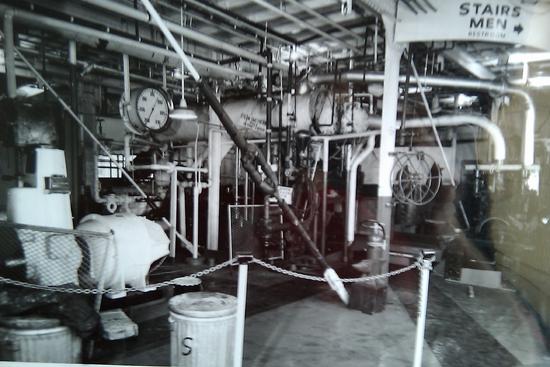
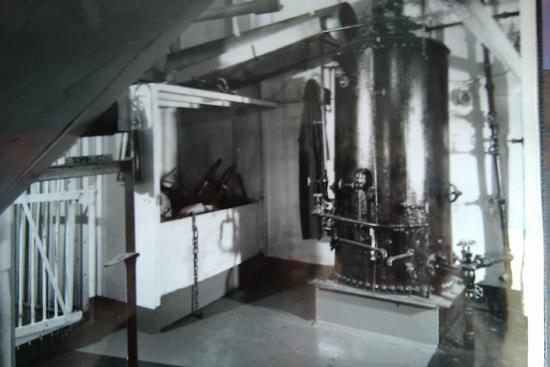
Steam gen-set, donkey boiler
I managed to dig up a couple of old photos. The first one shows the steam gen-set (which I think was a Skinner build) on the left side of the photo. This was replaced by the type of turbine we now have. The other shot shows the donkey boiler on the stbd. side of the boiler room. These days, we, instead, use air compressors when firing the boiler with no steam. We normally use our main fire pump (electric) or city water to fill our boiler when there's no steam. We also have portable gas pumps I've seen used in the past (when our fire pumps both operated on steam). Filling our boiler with city water can be painfully slow (over 6,000 gal.), so using the gas pumps gave a little boost.