
Topic starter
15/04/2011 12:21 pm
From the Fulton Illinois Journal June 22 1883:
In 1802 Oliver Evans agreed with James McKeever of Kentucky and Louis Valcourt to build a steamboat to ply between New Orleans and Natchez. The boat was constructed in Kentucky and the engine - high pressure - at Philadelphia, and both were sent to New Orleans, but ere the craft could be fitted it was destroyed by a hurricane, and the engine set to do useful though inglorious service sawing timber. This was five years before Fulton's successful Clermont ascended the Hudson.
The article then goes on to discuss the 1811 NEW ORLEANS in detail.
15/04/2011 7:58 pm
Absolutely fascinating!
Thanks for digging this up Judy. This is good stuff. It's absolutely fascinating that the first steamboat could have been on the Mississippi, instead of Fulton's vessel.
Fulton would probably still have gotten the credit for being the first because of his location. Investors and media hounds always have hire regard for what they see on the East Coast rather than anything to come out of the "frontier." Considering the plight of Mississippi and Ohio River vessels like the MQ, DQ and AQ, that still holds true today. If any of these boats were located on the Hudson or Potomac Rivers, they would never have gotten into this condition. Heck, the DQ would probably still have its exemption from SOLAS because New York Congressman would have made sure of it because it impacts them. Out here on the frontier - who cares.

15/04/2011 8:09 pm
I'd really like to read this article. Where can I get a copy?
Topic starter
15/04/2011 10:43 pm
Here is a scan of the badly photocopied article
Here is a scan of the photocopied article...don't know if you can enlarge it to read it, but I typed the only part that dealt with the 1802 boat. I've since googled some more information but can't copy and paste, so I'll have to retype it I guess.
Topic starter
16/04/2011 1:17 am
From American Heritage
In the Fulton Illinois newspaper article, the boat and engine didn't get together because of a hurricane. This version has a flood as the problem.
In 1802 a stranger from the West with an imaginative idea called on Evans. Louis Valcourt, a French émigré who had settled in New Orleans and had heard of Evans’s steam-engine theories, wanted to build the first steamboat on the Mississippi. Evans designed and built an engine, shipped it by sea to New Orleans, and got it installed in a hull prepared by Valcourt’s partner, Capt. James McEver. The skillfully prepared enterprise deserved a better fate than it received. The Mississippi happened to suddenly flood, sweeping the steamboat a half-mile inland and grounding it beyond recovery. McEver and Valcourt extracted themselves financially by selling the engine to a local sawmill. There it performed so successfully that local sawyers, seeing their livelihood threatened, burned down the mill.
Topic starter
16/04/2011 1:23 am
from History of Steam Navigation by H. Morrison 1903
This gives more info on the boat and engine, but the reason for not running the boat in this version is LOW water... regardless of the different reasons, all versions have the engine ending up running a sawmill...
In the year 1802, Captain James McKeever, U. S. N., of
Philadelphia, Pa., and Louis Valcourt, built a vessel in their
joint interests, of 80-feet keel and 18-feet beam, in Kentucky,
that was floated to New Orleans, and there fitted with an
engine and boiler built by Oliver Evans. The cylinder of
the engine was 9 inches diameter and 36 inches stroke, and
boiler of the flue type of 42 inches diameter. The river having
fallen so much before the completion of the vessel as to leave
her high and dry, and the river not likely to rise sufficiently to
float her for six months, the engine and boiler, etc., were taken ^ *
out and set up in a saw-mill, where it operated until the mill Of
was destroyed by fire. But for one of those unfortunate acci-
dents which so often defeat the best-laid plans, Oliver Evans ^ J ij.
would no doubt have had the satisfaction of seeing one of his
steam engines in successful operation on a steam vessel pre-
vious to those on the Hudson River. Mr. Stackhouse, who
subsequently carried on the building of steam engines at
Pittsburg, Pa., was one of the mechanics sent to New Orleans
to erect the engine in the vessel. N
In 1804 he constructed, for the city of Philadelphia, a
machine for dredging the slips of the city. The machinery
was placed on a large scow, 30 feet long by 12 feet beam, with
a steam engine 5 inches diameter of cylinder by 19 inches
stroke, operating the machinery. When the boat and ma-
chinery were completed at the shop in Philadelphia, it fur-
nished its own transportation to the Schuylkill River, wheels
and axles having temporarily been fitted for the occasion,
and when it was launched, a stern wheel was fitted, and with
14 EXPERIMENTAL STAGE.
its own power was driven down the Schuylkill to the Delaware
River, and up the latter river, in all some fourteen or fifteen
miles, thus clearly demonstrating the practicability of steam-
boats. In a patent suit in 1813, he says, regarding this
dredge boat: " But in this I was sadly disappointed, for they
made no allowance for the disproportion of the engine to its
great load, nor for the temporary manner in which the ma-
chinery was fixed, nor the great friction, ill form of the boat,
etc., but supposed it was the utmost I could do. Had I been
patronized, as Mr. Fuiton was, by the State of New York,
with the exclusive right for thirty years, and by a Mr. Living-
ston with thirty thousand dollars, to make the experiment, I
might have showed steamboats in full operation before Mr.
Fulton began his boat, which was finished in 1807, twenty
years after I petitioned the legislature of Pennsylvania, and
three years after the mentioned experiment."
^His son George Evans opened a shop in Pittsburg, Pa.,
in 1812^tthis was the next year after Fulton built the " New
Orleans " and, in 1816, built high-pressure engines for two
western river boats the " Franklin " and the " Oliver Evans,"
The steamboats "Etna" and the "Pennsylvania," that
run on the Delaware River about 1820, were each fitted with
Evans high-pressure engines. Rush and Muhlenberg were his
successors in business, and up till about 1840 were at the old
works.
Topic starter
16/04/2011 1:50 am
3 more versions
Sorry, but these wouldn't copy and paste from the original, so this is the best I can do without retyping them...


16/04/2011 6:37 am
hi all
JUDY HAS IT RIGHT, THE 1802 New Orleans boat and the saw mill story. and the Philadelphia dredge. Evens was a good engine builder and there is a rather large book on his live and that of his son in Pittsburgh and their engines. just remember that in the beginning a low pressure engine was about 10 PSI or less. the back stroke was aided by a squirt of cold water into the cylinder condensing the steam and making a vacuum. The High Pressure engine was not so high as the pipes were made of copper and at a certain point< if I remember right around 40 psi the steam was so hot it would distort the pipe. I think the cut-off valve idea was first tried on the Western Engineer in 1818. I think I saw the arms for this also on the Missouri Packets engine 1819. Engine now on display at the Arabia Museum in Kansas City.
don't ask what else I know/
16/04/2011 9:59 am
scans
Thanks, Judy, for going to the trouble doing the the scans, typing the Morrison 1903 history and posting them. The scans were readable. It's all very interesting. I think I'll root around in Google and see what else I can find about this. It's not fair how history sometimes works. Evans-McKeever-Valcourt ran the first steamboat on Western Rivers, but Fulton gets the credit and NEW ORLEANS gets the glory. Seems the guy with the money and good PR gets wins. Still that way I'm afraid.
Topic starter
16/04/2011 12:32 pm
It never was operational
I think the reason this boat got no credit is that apparently it never actually was under power. It was built, or not completely built, according to which version, and a hurricane/flood/low water kept it from any trial runs. Because they needed money, they removed the engine and put it in a sawmill, which eventually burned down, and no further attempts to power that boat were made. I wonder what happened to the boat itself?

16/04/2011 3:30 pm
More on George Evans
Another good source for early steam engines is "Power Makers: Steam, Electricity, and the Men Who Invented Modern America" by Maury Klein. Klein states that George Evans (Oliver's son) and his "partner Luther Stephens began building high-pressure engines after their works opened in 1811" in Pittsburgh. A boat named Franklin was built in Pittsburgh in 1817 according to BM Laughlin and 1816 according to Lytle-Holdcamper. The Oliver Evans is listed by Lytle-Holdcamper under the name of the Constitution built in 1816. BM Laughlin does not list a boat with that boat.
There is no appropriate Etna listed in Lytle-Holdcamper, but there is an Aetna built in Pittsburgh in 1814 listed by BM Laughlin.
Confirming facts on old steamboats are hard to come by -- dates differ, names are spelled differently.

16/04/2011 3:44 pm
Gone With The Wind
Well, maybe so, but where are all those walking beam steamboats that used to ply the Hudson and New York harbor not so long ago???

21/04/2011 3:57 pm
Hello,
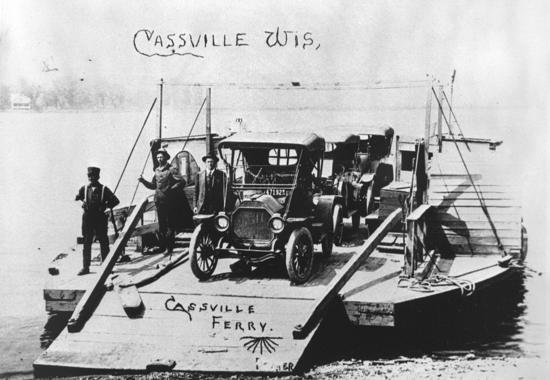
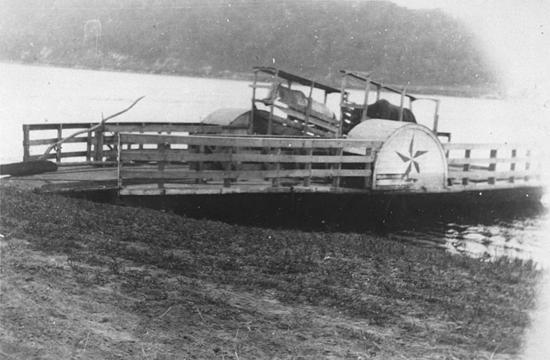
You might also be interested to know about another early attempt before Fulton. In 1807 a boat builder in New Orleans created a "horse boat." Horses were put on a type of treadmill that was somehow connected to paddlewheels. The destination was Natchez, but twelve to twenty horses became too exhausted and the trip was abandoned.
Robert Gudmestad
22/04/2011 2:16 am
Now THAT is a fascinating concept. Do you have any articles or sources that you could post for those of us who wish to do further digging?
22/04/2011 5:39 am
Well E. W. Gould in his Fifty Years on the Mississippi or Gould's History of River Navigation on page 40 describes the boat mentioned above. you may also want to look ad page 2 and 698. I have forgotten the exact source, likely National Geographic, of a horse powered ferry found in Lake Champlain in New York state. In Gould he references the New Orleans Gazette of 23 July 1807 the boat was advertized for passage to Louisville, with John Brookhart, Master.
old Mo Riverrat

22/04/2011 4:51 pm
Here a couple of pics of a small horse ferry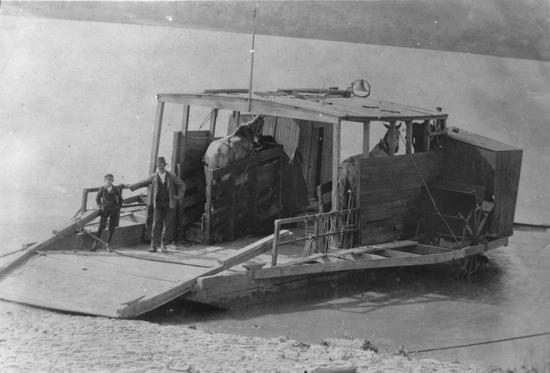
23/04/2011 3:09 am
Wonderful pics!! I'm very impressed.
25/04/2011 8:18 pm
Haites, Mak, and Walton in Western River Transportation, page 17, refer to horse boats. They cite the New Orleans Gazette, July 23, 1807 as quoted in Ethel Leahy, Who's Who on the Ohio River, page 60.
13/05/2013 3:22 pm
I think Fulton always managed to get the credit as the first... "Sucessful" not The first....
History is well aware that Robert Futon did not invent the steam boat... he did however invent many other amazing things (things that actually "worked" anyway) including the torpedo, underwater mines and the submarine. to name a few ! pretty amazing guy if you think about it. And it is also widely known that with his partner and father-in-law Robert Livingstons political and vast finacial influence and power Robert Fulton's ventures did manage to succeed where others only managed to be of passing historic interest. I think history has been quite fair actually.
If Robert Fulton had not died an untimely death in 1815 I am sure he would have commanded even more space in the history books. I don't share the thought that history has been unfair to others.... And He certainly did not influence later information in print.. His North River Steam Boat in 1807 commanded the brunt of many jokes by everyone... and even open agression by competitive river boat captains and companies back in the day. His determination to see that his boat was a financial sucess as well as just making a trip .... along with perfect timing, and the perfect river in need of speedy transportation and the eyes and imaginations of every saw mill owner along the hudson, every mill owner or industry of any kind that needed water power or where the use of this new fangled "Steam Power" could create a new business.... as well as every river transportation company and shortly later ocean transportation.. that realized their sails were going to be made obsolete caused this nations "Industrial Revolution"..and perhaps in great part "the worlds".. Military adaptation of Steam was also first pattented and advocated by Robert Futlon... as closed minded as our military was back then... he forced the issue and proved his point. Fulton's Boat on the Hudson created this frenzy, and is rightfully known as the most important event that influenced our modern day industrial might. And this revolution was the single most expansive event in human history. I have never seen any credit him as the First.... only the first to be profitable and therefore sucessful in any business venture he started. And for what its worth when you look at it..... this is accurate.
As far as I am concerned, this guy was privilaged but he used that advatage to create some amazing things.... he did not just live as a wealthy man and do nothing of interest to history... This guy was one cool dude and had some vision. The early inventors of Steam Power are well known to history... All of them...They have their due credit...
For what its worth from a newbee to the site.... my two cents
Randy
15/05/2013 10:32 pm
Define "successful"! John Fitch successfully demonstrated the concept a long time before Fulton. Fitch did it with scheduled service for a far longer time than Fulton's first venture up the river. The fact that the populace was not ready for it takes nothing from Fitch's success. Given that, when was Fulton's concept a success? He certainly made no money on his early trips and certainly not with Nick Roosevelt's first trip down the Ohio/Mississippi Rivers. So if it was Fulton, just what was the date when his boat finally became a "success"? It was not Fulton who ignored Fitch, and others, it was conventional wisdom...and the US Patent Office under Jefferson who issued a successful patent for a steam powered boat to both Rumsey and Fitch ON THE SAME DAY...thus chilling off their financial backers and the scheme collapsed for a couple of decades. You can bet that Fulton read every SCRAP of information about Fitch, Rumsey and others before he started. Fitch and Rumsey suffered under an embargo on English engines and they had to cobble up their own engines using local blacksmiths while Fulton was free to import comparatively sophisticated engines from Bolton & Watt in England...as he needed. Cap'n Walnut
15/05/2013 11:52 pm
Well Tom, if you want to debate history, find someone else to do it with...
I love the topic but refuse to spend what time I have expalining well known facts.
And if you really need me to explain how the word "Successfull" became linked with Robert Fulton's achievments... you'll have to debate with every historian, fellow inventor and newspaper man who's come to this same conclusion since those times, first...... before bothering to try and change my simple views of the guy. I don't carry his torch, I just simply respect what he did.
Fulton was an intelligent man, an artist and a visionary... he married into a wealthy and super influential family..... some people hold that against him. I can see the rub. Truth of feelings like that are; ....
... Poor men..... even poor men with great creative vision, intelligence and determination and do not often get the chance to do the wonderful things they may have been able to with their lives. This was true then.... and its true now. This does not however, change the fact that Fulton was quite an important character in early United States History. And he did not recieve this status in history because of unfair political influence.
I am still wondering if this site can answer the (what I thought was a) simple question I posed in my first thread about the name of the first steam boat company on the Mississippi. and if there is any paper trail from that business.... Stock certificate..... or even a letter head in some museum somewhere... So far I have found NOTHING.... this seems odd to me.
Can anyone help with that?
Randy
17/05/2013 2:16 am
Randy: Totally agree with all you say. And I was not debating history, only stating it as recorded. As the the first steamboat company on the Mississippi, why would this not have been Fulton and Livingston. They held the sole rights to the river, impounding rival boats and cargoes and jailing the rival captains until Henry Shreve busted it wide open when the court, where action against Shreve was brought, was determined, rightly or wrongly, not to have jurisdiction. There should be a paper trail. Good luck.
17/05/2013 11:59 am
Yes... the paper trail... And BTW I agree that the practice of building a monopoly is totally unfair and should not be viewed through histories eyes as something to be proud of... But back in the day it was the way of the world. And those who had the political where-with-all and the ambition to make money used their influence at every turn. history does not hide this fact, So again Fulton and Livingstons practices are well known. We have laws that protect business now but the game is still played much the same.
Tom.... do you happen to know the name of the company by any chance...?
Can anyone direct me toward a book that does or perhaps a historian who is well versed in this early era....?? Come on... there must be someone in here that can answer this question.
So far I must have stumped the whole group with this simple question. Seems impossible, but like the paper trail (that seems it must exist) I can't find ANYTHING..... Nothing.... Anywhere.... I think something like a stock certificate must be a one of a kind.... if you can find one at all. And anything written by Fulton concerning this company would be even harder to find.
Anyway I am still looking and asking. So far no one knows much. Seems odd considering the amount of excellent historians there are that have an interest in Mississippi River lore. Right?
Randy
17/05/2013 8:00 pm
There's an answer out there somewhere.
Randy, I guess we'll just have to hit the books and do a little digging.
BTW, about ten years ago I had a knock-down, drag-out argument with some on-line acquaintances in England/Scotland who will challenge you (to a man) that the REAL inventor of the first "successful" steamboat was NOT Mr. Fulton. They were ALL in common agreement that Wlliam Symington should have the credit. They cite the following:
1789 A small steam-powered, double-skiff with sidewheels that operated on
the Miller Estate (Scotland) attaining 5 mph. Operated by William
Symington.
1790 Another successful run with the same vessel on the Forth and Clyde
Canals averaging 6-7 mph. Operated by William Symington.
1803 THE CHARLOTTE DUNDAS. A steam-powered, sidewheel tug
(with a Watt engine). Ran 19 1/2 miles in 6 hours on the Forth and
Clyde Canals. Operated by William Symington.
I agree the credit should go to Fulton. There is a large contingent across the pond that does not agree. There is a long list of others that helped make it possible for Fulton to achieve "first successful" - and, I suppose there will always be some disagreement based on defining the word "successful." Having said that, here are a few others who helped:
1763 William Henry. (Lancaster, PA)
1774 Perier Freries. (experiments on the Seine River, France
1782 Marquis de Jouffroy d' Abbans. Saone River, France. Vessel ran for
about 15 minutes before the bottom gave way.
1787 James Rumsey. (Shepherdstown, West Virginia). Potomoc River.
"jet" propulsion engine averaging 2-4 mph. Ran continuously for about
two hours on first trip. Second trip averaged 4 mph.
1787 John Fitch. (paddles along the side of vessel). 3-4 mph.
1787 John Fitch. (second vessel PERSEVERANCE).
1789 William Symington. (Miller Estate, Scotland). 5 mph.
1790 William Symington. (Forth & Clyde Canals) 6-7 mph
1790 John Fitch. VesselTHORNTON. Made 7 mph in service between
Burlington, Bristol, Bordentown and Trenton. Accommodated excursions
out of Wilmington, Gray's Ferry and Chester. Made between 2,000-
3,000 miles without a serious accident.
1790 Samuel Morey. Experiments on the Connecticut River.
1790 John Fitch. Awarded U.S. patent for invention of steamboat on
August 26, 1790.
1792 Elijah Ormsbee. Vessel using atmospheric engine and duck-foot
paddles
at Windsor's Cove, Narragansett Bay. 3 mph.
1793 Rumsey's final vessel. 4 kts. Ran for an unspecified distance
by his partners.
1793 Samuel Morey. Sternwheel powered steam vessel. Ran Hartford
to New York in 1794. 5 mph.
1796 John Fitch. Screw-propeller steam vessel.
1796 Griffin Green. Built a boat with steam engine. Went bankrupt before
completed.
1797 Samuel Morey. Sidewheel -powered steam vessel.
1803 William Symington. Clyde & Forth Canals (Scotland). 19 1/2 miles
in 6 hours.
1804 Capt. James McKeever and Louis Valcourt. Kentucky. Engine and boiler
by Oliver Evans. Engines: 9" x 36". Flue-type boiler: 42" diameter.
Taken to New Orleans and abandoned.
1804 Robert Fulton. (France) Seine River steamboat trial. 3-4 mph.
1804 Robert L. Stevens. Steam vessel. Screw propeller. Engine: 10" x 24".
Boiler: 50 lbs. pressure. Ran New York to Hoboken.
1807 Robert Fulton. First commercially successful steam -powered vessel.
NOTH RIVER STEAMBOAT. Side paddlewheels. New York to Albany
(150 miles) in 32 hours (5 mph).
1808 John Stevens. (Philadelphia). Vessel PHENIX. First steamboat to
navigate the ocean. Perth Amboy to Paulus Hook (30 miles at 5+ mph).
So why is Fulton generally credited with the invention of the steamboat and Fitch, Symington and a host of others are not? Here is the case, as I see it, for the credit going to Fulton.
Fulton carefully studied the work of most all of those who preceded him and combined all of their successes and made a steamboat that not only worked, but was commercially successful. Not a single part of his NORTH RIVER STEAMBOAT was his own invention – although he had patented improvements on much of the machinery. His was, without question, the first “useful” steamboat. His vessel was the product of accumulated knowledge; not an isolated phenomenon as was those that preceded his. He took the best from each of the others, combining and improving on all of the pieces until the result of this synergism was success. The time was right. Acceptance was at hand. The boat worked. People could ride in it and did – and it paid its own way – no longer an experiment or demonstration. After the NORTH RIVER STEAMBOAT began running, steamboats began to proliferate – success-breeding success – the ultimate testament. Those who came before Fulton, however brilliant and worthy, were only martyrs in the cause, because the times were not yet ready. Because of these reasons, I believe Fulton deserves credit for being the inventor of the first successful steamboat. Was he the first to make a boat move under the power of steam? No. Was he the most creative and most useful man connected with the invention? Probably. Yet, it was not until after his first successful trip in 1807 that we saw the fruit of his genius – his ability to improve upon his designs and continue at will to build effective steamboats.
The principles of his success were so clear and well stated that others were able to follow his lead and repeat his efforts. Steamboats proliferated everywhere. It had ceased being a philosophical experiment and had become a practical and reliable method of transportation.
Fulton was the right man at the right place at the right time in history. He was active and at the top of his game when the fruition of his efforts became possible. Anyway, that's what I think.
Now let's see if we can track down that answer for Randy.
17/05/2013 9:42 pm
Yes before this thread becomes locked in the never ending battle for bragging rights.... I am looking to find the name if his company.. And if any Stocks or paper trail exists in any form from its formation..
Technically this is not my thread anyway..... so now that I have hyjacked it, please find my previous thread where this question as posted about Fulton's Company and any Stocks or Paper trail and if anyone can find anything please post it there.
As as for sucessfull... Again
I don't carry Fulton's banner around in front of me. I am still, however, impressed with his many accomplishments.
Randy
Page 1 / 2
Next