Topic starter
24/12/2007 8:00 pm
Steamboating colleagues:
A recent posting by Lexie mentioned her family's history and journey to Texas in the 1830s. A recent discovery here in a Cincinnati book store produced a volume 'A DIARY IN AMERICA, 1839' by British captain Frederick Marryat 1792-(1848). Marryat, son of upper class member of Parliament, went to sea at age 14 seeing action in the Napoleonic wars, also the distinction of being naval guard for Napoleon exiled at St. Helena. He became a noted writer and friend of Dickens in addition to many American writers and statesman, Henry Clay being one. His travels in America put him in Cincinnati at the time of the MOSELLE explosion here in 1838. His account of that event, and related observations of steamboat design and operation here, are remarkable. At first Marryat looked a bit askance at our steamboats on the rivers until he came to understand their needs, design and the waters upon which they steamed. In time be became totally 'hooked on our steamboats and penned his sentiments traveling on the Mississippi. Unfortunately, like so many contemporaries on their grand tours ot America, he neglected to record the name of this 1830s steamboat.
* * * * * * * *
"Talk not of your northern steam-boats! A Mississippi steamer of seven hundred tons burthen, with adequate machinery, is one of the sublimities of poetry. For thousands of miles that great body [*Steamboat] forces its way through a desolate country, against an almost resistless current, and all the evidence you have of the immense power exerted, is brought home to your senses by the everlasting and majestic burst of exertion from her escapement pipe, and the ceaseless stroke of the paddlewheels. In the dead of night, when amid the swamps on either side, your noble vessel winds her upward way--when not a soul is seen on board but the officer on deck--when nought is heard but the clang of the fire-doors amid the hoarse coughing of the engines, imagination yields to the vastness...and mightiness of art in contrast with the mightiness of nature.
Such a scene, and hundreds such have I realised, with an intensity that canot be described, always made me a better man than before. I never could tire of the steam-boat navigation of the Mississippi." END
* * * * * * * *
MERRY CHRISTMAS & HAPPY NEW YEAR TO ONE AND ALL!
Cheers,
R. Dale Flick

24/12/2007 9:02 pm
Yes, I think we all know here how a trip by a rolling paddle wheel can make a better person of us all.
Merry Christmas, Everyone!
Frank

25/12/2007 3:26 am
On Christmas Eve
Bonfire on the bank, hard bend to the right,
On the lower Mississippi, full moon tonight.
Where the Spanish moss, hangs from the trees,
Down in Louisiana on Christmas Eve.
That muddy water,
Never quite comes clear.
When I try to give a reason,
Why I want'a be here.
Ain't ya got no family?
No place to be...?
Out on the river,
On Christmas Eve.
JH

25/12/2007 10:52 am
One of the most piteous things in this world is to listen to river radio traffic between Thansgiving and Christmas. Other than deciding which whistle to take, the talk is almost exclusively about who will have off days at Christmas. Those who know they are stuck mourn. Those who hope to be off commiserate without bragging, lest something change the work schedule.
Merrie Christmas, everyone.
Topic starter
06/03/2008 10:16 pm
Steamboating colleagues:
To continue an earlier December posting RE: 'Steamboating's rough and tumble 1830s' I reference again the volume written [*See above] from the pen of Capt. Frederick Marryat, British Naval officer, son of a 'merchant baron' who was a member of Parliament. His account penned in the year 1838 covers aspects of his grand tour of America with insights on our steamboats and railroads of the day. He was not without certain prejudices or jaded views but relished his trip in an emerging new nation. The below is excerpted from his chapters on 'Tavelling.' Spellings of the day and usage preserved for the flavor.
* * * * * * * * * *
"When I was on board of one of the Mississippi steam-boats, an American asked one of the ladies to what she would like to be helped [*Dining at the long tables in the boat's main cabin]. She replied, 'to some turkey,' which was within reach, and off of which a passenger had just cut the wing and transferred it to his own plate. The American who had received the lady's wishes, immediately pounced with his fork upon the wing of the turkey and carried it off to the young lady's plate; the only explanation given, 'For a lady, Sir!' was immediately admitted as sufficient.
The authority of the captain of a steam-boat is never disupted; if it were, the offender would be landed on the beach. [*Accounts of this happening are recorded in other letters and monograhs of the day.] I was on board of a steam-boat when, at tea time, a young man sat down with his hat on. 'You are in the company of ladies, Sir,' observd the captain very civilly, 'and I must request you to take your hat off.' 'Are you the captain of the boat?' observed the young man, in sulky tone. [*Uniforms for officers were not known until later in steamboat trades.] 'Yes, Sir, I am.' 'Well, then, I suppose I must,' growled the passenger, as he obeyed. But if the stewards, who are always men of colour, were to attempt to enforce the order, they would meet with such a rebut as I have myself heard given. 'If it's the captain's orders, let the captain come and give them. I'm not going to obey you.'
Frederick's trained observations as a professional sailor under sail and emerging steam for the British Fleet fell on the construction and eqippage of steam-boats. "Clauses for inspecting them [*Steam-boats] are judicous as far as the inspecting of them is regulated; but that of iron chains or rods for tiller ropes is not practicable on a winding river, and will be the occasion of many disasters. Had they ordered the boats to be provided with iron chains or rods, to be used as preveentive wheel-ropes, it would answer the purpose. ...Here using such on boats to steer them in a tide-ways [*River currents] is almost impossible."
* * * * * * * * * *
Capt. Marryat held in horror the practice on our steam-boats where common hair brushes and tooth brushes in the lavatories for men were shared in 'common.' He linked this to the prevalent belief that Americans suffered "from the itch."
Cheers,
R. Dale Flick

06/03/2008 10:43 pm
I am ashamed to say that I cannot now remember who said it, but SOMEONE said, "What the use of being a steamboat captain if you can't tell someone to go to hell?"
Topic starter
06/03/2008 11:22 pm
Hi, Bob & steamboating colleagues:
Bob, that was a good one about steamboat captains. The 5th entry above carries on the monograph by Frederick Marryat. Though most high-born in old England, he was rough-and-tumble going to sea at age 14 to make his own way under sail with all of the cruelty, brutality and iron disicipline to the point of unreasonable that era was known for. Highly educated he was the friend of Charles Dickens and other writers of his time with his own novels and histories in print. His rare 1839 volume I have here is part diary and travel experiences. From what I've reasearched he impresses me as a cross between Indiana Jones, Mark Twain and, again, Charles Dickens...if such a troika is possible...but aristocratic to the tip of his fingers. Those of his class were open to the new spirit of America then but cautious in many of our democratic beliefs so typical of those in highly structured and class conscious Europe, of which England was an island appendage. Wait until I share with you all his other writings and his impressions of navigating the lower Mississippi River in light of postings we've seen today in/around the New Orleans area. He was not without critics and one stated at the time, "He writes too fast and too freely." In my vintage volume of his book next to a paragraph commenting on social customs in America somebody long ago penned, "Not so, Marryat!" Yes, I would have liked to met Capt. Frederick Marryat--just once.
More to come in time.
Cheers,
R. Dale Flick
08/03/2008 1:05 pm
For some reason, Capt. Tom Leathers of the Natchez comes to mind where that statement is concerned.
08/03/2008 1:39 pm
It was Captain Thomas P. Leathers, but I think he said ..."tell everybody to go to hell." Shucks, even I have told somebody to take that trip, but a REAL man is not so exclusive.
08/03/2008 1:56 pm
"What's the use," he said, " of being a steamboat captain if you can't tell people to go to hell?" A Treasury of Mississippi River Folklore. Part of why I wanted to be Capt. My interest fell off somewhat after reading this.
08/03/2008 4:57 pm
In a Hand Basket
Steamboating went all to hell when the Greenes sold out. Or as Captain Albert Kelly oft said, "It ain't the ole Greene Line."

08/03/2008 8:59 pm
R. Dale Flick;9000 wrote: Steamboating colleagues:
A recent posting by Lexie mentioned her family's history and journey to Texas in the 1830s. A recent discovery here in a Cincinnati book store produced a volume 'A DIARY IN AMERICA, 1839' by British captain Frederick Marryat 1792-(1848). Marryat, son of upper class member of Parliament, went to sea at age 14 seeing action in the Napoleonic wars, also the distinction of being naval guard for Napoleon exiled at St. Helena. He became a noted writer and friend of Dickens in addition to many American writers and statesman, Henry Clay being one. His travels in America put him in Cincinnati at the time of the MOSELLE explosion here in 1838. His account of that event, and related observations of steamboat design and operation here, are remarkable. At first Marryat looked a bit askance at our steamboats on the rivers until he came to understand their needs, design and the waters upon which they steamed. In time be became totally 'hooked on our steamboats and penned his sentiments traveling on the Mississippi. Unfortunately, like so many contemporaries on their grand tours ot America, he neglected to record the name of this 1830s steamboat.
* * * * * * * *"Talk not of your northern steam-boats! A Mississippi steamer of seven hundred tons burthen, with adequate machinery, is one of the sublimities of poetry. For thousands of miles that great body [*Steamboat] forces its way through a desolate country, against an almost resistless current, and all the evidence you have of the immense power exerted, is brought home to your senses by the everlasting and majestic burst of exertion from her escapement pipe, and the ceaseless stroke of the paddlewheels. In the dead of night, when amid the swamps on either side, your noble vessel winds her upward way--when not a soul is seen on board but the officer on deck--when nought is heard but the clang of the fire-doors amid the hoarse coughing of the engines, imagination yields to the vastness...and mightiness of art in contrast with the mightiness of nature.
Such a scene, and hundreds such have I realised, with an intensity that canot be described, always made me a better man than before. I never could tire of the steam-boat navigation of the Mississippi." END
* * * * * * * *MERRY CHRISTMAS & HAPPY NEW YEAR TO ONE AND ALL!
Cheers,
R. Dale Flick
Steamboaters,
I have been checking most everyday on this site to see what is new with the Community. Myself I have been sick and have lost my job and am now on perment disability. Old steamboating is still my love and have been researching that trade or craft before the Civil War, War between the States, War of Nothern Aggression or Southern Independance. Nearly eighty years ago a researcher got a tip about a journal kept by the pilot Isaiah Sellers. When others wanted to know more about what it contained the story was that it was destroyed in a fire before WWII. Myself I never bought that fire story. In November of 2006 never leaving my apartment using the internet and the telephone for a few days I located the journal 1825 to 1862. The owner also has Sellers LogBook that is from 1844 to 1862. I'm still in negotations to copy and publish these treasures, when I do you will be the first to know
Topic starter
09/03/2008 3:46 pm
CAPT. TOM LEATHERS/"IN A HAND BASKET:
Thanks for nailing down the quote to Capt. Thomas Leathers. Those were the days when many captains also owned their own boats. With this came grinding duty, responsibility and worry 24/7/52. Old letters/accounts mention again and again 'Capt. visited commission houses, shippers, U.S. Customs House, agents ashore, grocers." This in addition to touching bases with offices on wharfboats and talking to captains on other boats to sniff things out. In most cases captains and officers held their distance from passengers other than the 'courtly jestures of civil society as demanded in the securing of business.' Even 'Commodre' Fred Laidley of the L & C LINE personally walked from one Cincinnati steamboat machinist to another to dicker over $2 for a valve he needed on his boats. Somebody posted on here a long time ago about the fallacy of "the jolly, benign, fun-loving old captain" and it may have been Alan Bates. Leathers, and others of his ilk, may have had the right to tell people to "Go to h---" but one record indicates a young Purser had the last word in simply placing the office docket down on the table, pointed to the bottom page for the month underlined in red saying, "Sir, this for your immediate attention." OUCH!
The 1830s was a period of massive emigration to America. Capt., Marryatt related an account from several steam-boat captains telling of incidents carrying groups of young immigrant men. "He [*The captain] received them on board, and said that sometimes, if they were very few, they would declare at the end of the trip that they had no money, although when detained they never failed to produce it; if they were very numerous they would attempt to fight their way [*Ashore] without paying. [*Makes us wonder why passage wasn't collected when the boarded and how many worked their passage off on the lower decks hauling cargo or wood with the regular crew]. One said he had no money, when the captain, to punish him, seized his old jacket, and insisted upon retaining it for payment. "...the captain jerked it overboard. 'Oh! murder!---captain, drop the boat, pick up my jacket up, or I'm a ruined man. All my money's in it." [*Yawl from the deck]. The jacket was fortunately picked up before it sank, and, on ripping it up, it was found to contain, sewed up in it, upwards of fifty Sovereigns and Gold Eagles." [*Sovereign was for years a coin of gold in Great Britain varying in worth from on/around $40 to $50. There was a lack of coinage in America then with many foreign coins in gold, silver being so honored].
"The same captain related particulars of one instance in which one hundred immigrant men were on board, who when asked for payment, commenced an attack upon the captain and crew with their bludgeons; but, having before experienced such attempts, he was prepared for them, and receiving assistance from the shore, were worsted, and then every man paid his fare." So much for early 'steamboat romance.'
Cheers,
R. Dale Flick
09/03/2008 11:29 pm
Dale, I so often have to remind myself and others that what we perceive to be a recent decline in civility and rise in dishonesty is really nothing more than our perception. Not only was this going on in the 1830's, but indeed has been going on since time began -- we read about it in the Bible even.
It amazes me that those guys made money, having to be ruthless in every way. And Capt. Marryat couldn't just pick up the phone, go on line or even hop in the car for a quick trip to the next vendor in search of his $2.00 savings. They had all of the problems of today with none of the conveniences, save for being able to conscript cheap labor at times. The more things change, the more they stay the same.
Topic starter
12/03/2008 7:08 pm
Str. BEN SHERROD by Frederick Marryatt:
Steamboating colleagues:
British captain/member of the Admiralty Marryatt, penned in his travels impressions of steam-boats in America. His views varied and his keen eye saw differences in construction and "fine finish work." Below his narrative done in 1838 during his 'grand tour' of America.
* * * * * * * * * *
"The cabin of the BEN SHERROD was on the upper deck, but narrow in proportion to her build, for she was what is technically called a Tennessee cotton boat. To those who have never seen a cotton boat loaded, it is a wondrous sight. The bales are piled up from the lower guard wherever there is a cranny until they reach above the second deck, room being merely left for passengers to walk outside the cabin. They have regular alleys left amid the cotton in order to pass about on the first deck. Such is a cotton boat carrying from 1,500 to 2,000 bales [*Note: Not the largest cargo of such as appeared in later steamboating days].
"The BEN's finish and accommodation of the cabin was by no means such as would begin to compare with the regular passenger boats [*On the Mississippi and larger streams]. It was late in the season and few large steamers being in port in consequence of the severity of the times [*The big financhial 'Panic' as recorded by others and in the records of the Howard Steamboat Museum]. The BEN SHERROD got an undue number of passengers, otherwise she would have been avoided, for her accommodations were not enticing. [*We wish he had elaborated more on the 'finish' of the boat, cleanliness and foods offered]. She had heavy freight on board, and severeal horses and carriages on the forecastle. The build of the BEN SHERROD was heavy, her timbers being of the largest size. [*Marryatt studied American boat/ship construction recalling his early years under sail in the British Navy. England's fighting ships were termed 'The wood walls of old England'].
"Aboard steam-boats, and ashore, all of the bars have what they term a 'kicking board,' it being the custom with the people, instead of touching glasses when they drink together, to kick sharply with the side of the foot against the board, and after this ceremony you are sworn friends." More from Marryatt's pen in time. 'Steamboat History' is alive and well on Steamboats.org.
Cheers,
R. Dale Flick
17/03/2008 5:47 am
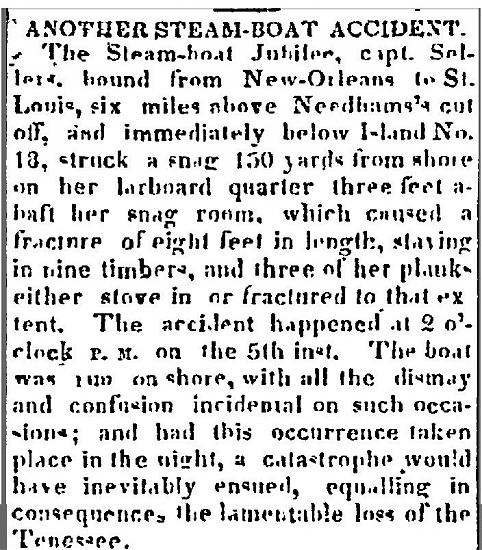
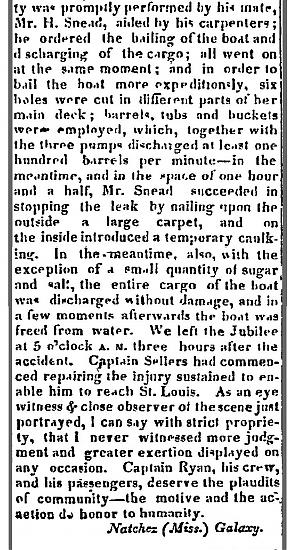
Rough and Tumble in the 1830's. Lets try 1828 with Capt Sellers and the Jubilee. See Atchments.