
Topic starter
20/02/2009 8:23 pm
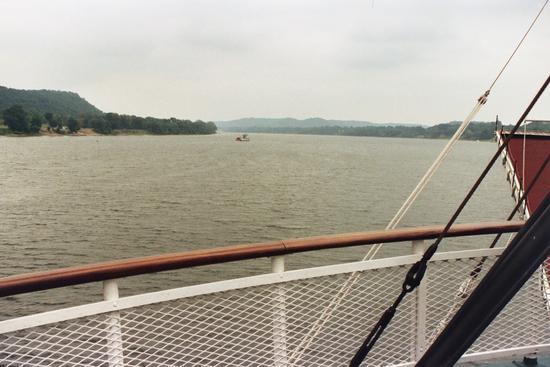
Captain Steve, I promised you some pictures of the little meeting of the gals this summer, and it plumb slipped my mind...anyways, more pictures from that great day, thanks.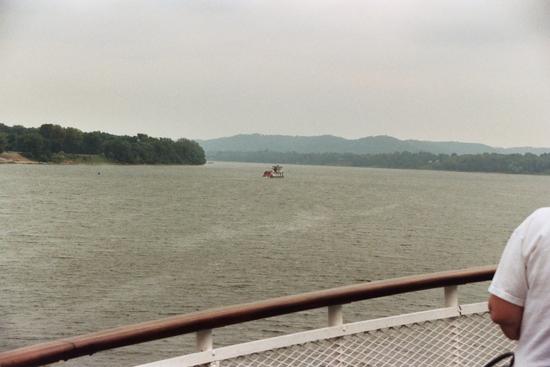

Topic starter
20/02/2009 8:28 pm
A few more, a little closer, about the same pictures as Pat has posted at various spots...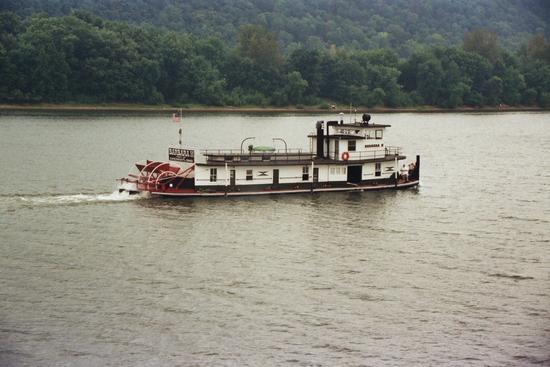

Topic starter
20/02/2009 8:30 pm
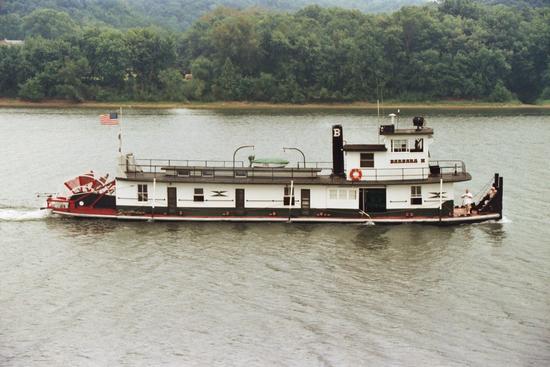
Last one, thanks again, what a thrill...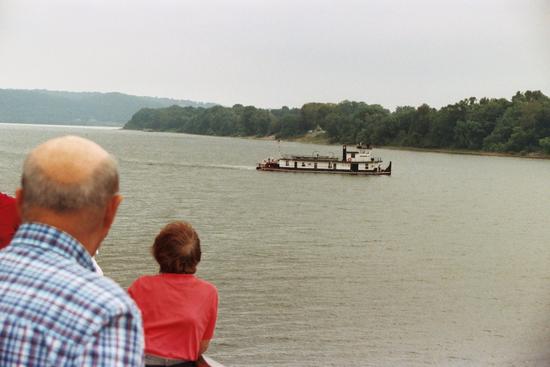

21/02/2009 12:11 am
Bruno, Many thanks for those!! It's sad to think that we will not see any of the Queens pass our landing this year.
21/02/2009 2:29 pm
We were in the midst of several Barbara H restoration projects last summer. Thought this thread would be a good opportunity to share some restoration work photos.
First set of photos shows the restoration of the Barbara H's original pilothouse wood flooring. For years it had been covered by 1960's brown vinyl adhesive tiles. Over the years, occasional roof leaks had damaged the tiles, so we decided to remove them to see what was underneath. In doing so we found the original 1923 tongue-and-groove wood flooring, just waiting to be restored!
We belt-sanded and refinished the floor using boiled linseed oil. My family had a 1929 sternwheel excursion boat with wood decking. The lower deck had always been treated with linseed oil since 1929, and that experience taught me how well linseed oil works. It is easy to maintain, and does better than varnish if it gets wet for extended periods.
The 3rd photo shows restoration of the pilothouse ceiling's green-apple-green paint.


21/02/2009 2:35 pm
Great photos Steve. The Barbara H is such a neat boat. I remember when I was younger us using linseed oil on hardwood floors in a kitchen, and then also using it on a deck outside. Stuff works wonders!
21/02/2009 2:41 pm
Here is another view that shows the pilothouse deck, refinished pilotwheel, and pilotwheel stand restored to its earlier black color.
Next, the lower cabin exterior on the port side had suffered from years of rainwater "splash", and this eventually created some dry-rot. I had babied this area since we got the boat in 2000, but it was time to repair this area. I had to special-order the tongue-and-groove board from a local sawmill, as I could not buy 2" flooring planks anywhere. The sawmill made the planks out of cypress, which works very well in wet environments, and is vitually knot-free. These 2 photos show the bad planking removed, and the repair work I did to some of the studs that had dry-rot damage.


21/02/2009 2:52 pm
More photos of the new cabin wood before and after paint. Also a photo of exterior paint.


21/02/2009 2:56 pm
Last photo showing Barbara H's "business end", and calm water reflection. We replaced 5 white oak bucket boards and 47 bolts. Also replaced some rusted portions of the chainguard with new steel plate.

21/02/2009 3:28 pm
Where did that sawmill get cypress? Is it heartwood? We re trying to decide on a floor for our new home in Colorado and have covered the waterfront looking for the right thing. We don't like the laminates. Too thin. Years ago I installed a hardwood floor in the cabin of the Graceful Ghost. Wish I had used the linseed oil instead of varnish, but it has held up pretty well. Linseed oil is scary. Rags soaked with it can spontaneously combust very easily.
21/02/2009 4:02 pm
We sold the 1929 sternwheeler in 1981, and by 1999 new owners decided it would be a great idea to varnish the lower decking, which was 14' x 55' of heart-pine planking, that had always been linseed oiled. They were gleeful to show me the wonderful varnish job they had done. Yes, it looked nice, but was slippery as heck when wet!
Then less than 1 year later the hull sprang a leak and she sat on the shallow lake bottom for 2 days. The varnish was of course ruined. If it had been the original linseed oil, they could have simply hosed it off, cleaned it with murphy's oil soap, and gave it another application of linseed oil (if needed). Instead they had to belt sand the entire deck and do the varnish applications all over again.
You're right -- gotta be careful with those linseed oil rags!
I too was surprised, and asked the sawmill about how they got cypress. I know that cypress is protected from logging, but I don't know to what degree. They said they go to southern Georgia/northern Florida region (Okefenokee swamp) and it can be purchased from lumber salvors who are allowed to take trees for whatever reason (storm damage, construction areas?). Here is their web site:
Tiny TIMBERS

22/02/2009 2:59 pm
Steve,
Great pictures...some day I have to motor up to Lamb and come aboard! It is one of those things I keep putting off for no apparant reason!
Travis
22/02/2009 5:11 pm
Travis,
Sure, stop by anytime. I guessed you missed us when we had the BH at Louisville for Industry Day in May '04. Can't believe that is almost 5 years ago now!
Topic starter
23/02/2009 2:29 am
Capt Steve, I have a few questions if you have the time. I take it the big gauge is steam pressure for your whistle? How do you make steam? Am I right that the two concentric wheels at the ceiling are your spotlight controls? And your wheel is chain driven through a transmission with a clutch?
23/02/2009 12:45 pm
The guage is compressed air. The boat has never been steam, but the big old diesel engine is air-start, so we need a lot of air to turn the engine over to start it. Once it gets started the engine has an air compressor cylinder that I can engage to keep the tanks topped-off. We have 250 gallons of air tanks that we try to keep at about 150 psi when operating. There are 2 electric air compressors. We use the generator or shorepower to run them if we need air to start the engine. Back in the day, they would have used a gasoline powered air compressor.
From 1923-1925 the boat had a gasoline engine, and did not need air start. But there was still air aboard for operating the steam whistles, which are original to the boat according to 1923 photos. It was not uncommon for gasboats to use steam whistles with compressed air.
Yes, the overhead wheels are for controlling the Carlisle & Finch spotlight, which is also original equipment.
Yes, there is a big lever in the pilothouse (visible in some of those photos) that engages or dis-engages the clutch. There is no gearbox. It is either engaged or not. To control the direction of the boat, you dis-engage the clutch, stop the engine momentarilly, start it up in the other direction, and re-engage the clutch. This is the old way known as "direct-reversing". The Barbara H is the last operating towboat with this setup. It is also the last operating sternwheel towboat with the engine located forward near the front of the boat, which was traditional for these boats.
Coming in for a landing, or locking, you can use a lot of air starting/stopping the engine. This teaches the pilot to really think ahead, and be as conservative as possible with the air available!
The clutch engages a 50' long drive shaft that runs from the engine flywheel to the stern, where it drives another short shaft with a pinion gear. The short shaft drives the chain to the paddlewheel.
Before 1926 the Barbara H had a gas engine and a completely different drive system. If you are familiar with old farm traction engines, it was like that. Instead of the long driveshaft there were 2 flat belts that were driven by the gasoline engine's flywheels. One belt had a twist in it, which gives you opposite direction. So one belt would be used for coming ahead, and the other for reverse. The belts would be clutched into place by various reach rods. These early gasboat drive systems were problematic.
Topic starter
23/02/2009 11:23 pm
Thanks Capt, I appreciate the answers...Direct reverse on a diesel? Never realized that diesels did that. There were famous outboards from the mid fifties that were direct reverse, Mercury's "Tower of Power" Mark 75 and the dock buster Mark 78's were first introduced with direct gearing and reverse start as a cheaper option to full gearshift lower units... Created a whole bunch of liability, imagine a 14 foot fiberglass boat unexpectedly started almost full power in reverse... It was cool to watch the motions of the magneto and carb linkage to start the Mercury's in reverse, great video on YouTube on this...But unlike the Barbara H the Mercury's didn't have a clutch.
Yeah, air start on a big cubic inch diesel, yeah I knew that, duhh...
24/02/2009 1:10 pm
Bruno, when I first went on the river there were a lot of BIG towboats with direct reversing diesels. Cooper-Bessemers, Kahlenberg, National Superior, Atlas, Busch-Sulzer engines. Most of these no longer exist. Talk about fun, imagine moving into a lock chamber, with current running and hoping the "darn thing" started in reverse. Though there were lots left in the 50's, I only worked on two. On both boats, the pilots I steered for had a trick of getting on the wall and then placing one engine in reverse at idle and working the tow into the chamber on the other. Maybe everybody did this. Remember here on the Ohio in those days we had a locking about every 25 miles. It tooks lots of handling. Also I understood that if the engine stopped on "dead center" it would not restart until the flywheel was rocked with a crow bar. Perhaps Alan Bates or Capt. Lehman could tell more.

24/02/2009 2:39 pm
For a while there was a pretty good industry salvaging sunken timber from old lumber operations, cypress among other species. Don't know if that is still going on or whether the stock is used up. If you can find an architectural firm that specializes in historic renovation, they might be able to give you a lead.
24/02/2009 3:23 pm
I've heard about that problem of stopping on "dead center". Fortunately it has never happened to me on the Barbara H. I have also heard that, when changing directions, if you get in a hurry and don't let the engine stop completely before applying air, it can start up again in the same direction. I've been in a hurry before, but luckily that has not happened to me (yet).
Another fun thing is starting these engines in the winter. You have to do what they used to call "cigarette start" them. There is a removable bolt in the top of each cylinder head. The bolt is hollowed-out just the right size so you can stick a lit cigarette in it, then screw it back into the cylinder head. This acts as a low-tech "glow plug" for starting the engine when it's cold. I don't smoke, so I use the method the previous owner taught me. That is to use short pieces of cotton sash cord, soaked in diesel oil, instead of cigarettes.
24/02/2009 5:57 pm
Steve when I bought SEWICKLEY it had a Cooper-Bessemer J-6, 150 h.p. @300 rpm.
It had a system of percusion caps on each cylinder, you set a cap in each slot, when you shot the air to it, a lever hit the caps and exploded them, igniting the diesel fuel. Totally unreliable and frustrating as I needed a good towboat, ready to go quick. After about three months I had a new G-M 6-110 installed.
25/02/2009 12:08 am
I sent for information. Thanks. Some of the old homes in Natchez have unfinished cypress. It is said to not need any finishing, but that might just be the heartwood, which is already loaded with natural preservative. Any wood that looks that good for over 100 years without finish is the wood for me. On the deck of the Graceful Ghost, after I installed the oak flooring, I wanted to make it look old, so I found an old can of paint thinner that my husband had used to put tar brushes in. The disolved tar had made it a nice dark color which I used like a stain. After that dried I varnished it with a really good spar type varnish. It has held up well and looks like it has been there 100 years, which was generally the look I wanted to achieve with the whole boat. None of that tar stained wood has shown the least sign of wanting to rot. It is covered but still gets exposed to the elements and has been tortured by thousands of heavy people scooting chairs over it for several years.
Topic starter
25/02/2009 1:46 am
No Glow Plugs? Really? Cigarette start? unreal...remove various (6?) bolts on the cylinder head, light 6 cigarettes, non filtered of course, simultaneously, shove them lit as fast as possible into the combustion chambers and torque down 6 bolts as fast as possible , hit the air start and pray at least half of the original cigarettes didn't go out...So I take it we don't try to start in the cold weather much, what a pain? Your engine will start without glow plugs (or cigarettes) if the weather is warmer?
To reverse the engine do you need to shift the cam to alter the valve and injector timing? I ask as it would seem that "shifting" the boat into reverse or back to forward would be a two man job, one at the engine, the other at the clutch lever...and the engine running backwards...water pump, oil pump, injector pump, are there any issues with the engine turning backwards, like "only operate this way for xxx minutes"? And I promise, no more questions.
The description that Capt Bill has below of the cap start reminds me of cartridge start on big radial aircraft engines...makes a big bang but doesn't necessarily get the job done.
25/02/2009 1:09 pm
Bruno,
There is a furnace on the boat for heating the engineroom in the winter. Lately I keep the engineroom temp at about mid-40s. The cylinder heads have mercury thermometers that indicate head temp. If they are 55 degrees or higher, it will start without glow plugs with a couple of attempts. Above 75 degrees it always starts on the first attempt. Below 55 degrees I put 1 glow plug in the aft cylinder to start.
In winter, on rare occasions I have put 2 glow plugs in, but it is too much work. I must use a short ladder to get to the top of the cylinder head (near the ceiling) to access the glow plug bolts. The aft cylinder is the easist to reach.
Some diesels have glow plugs for cold weather starting, but other than that, the glow plugs are not needed. I forget the exact specs, but you just need something like 550 psi in the cylinder to make the diesel/air mixture combust. The warmer the air temp, the better.
The engine is made to reverse easily. It is a direct-reversing marine diesel. You can run it forward or reverse as often as you like, as long as you like, without problem. There is a big crank wheel on the side of the engine that controls the air start. Turn it one way to start the engine "Ahead", and the other way for "Astern". These labels are cast right into the crank wheel. This crank wheel sets the cams for engine direction and sends compressed air to each cylinder in the proper sequence. It is a giant 2-stroke engine, which means it has no external push rods, rocker arms or valve lifters. It scavages air from the crank case.
Yes, before 1940, when SOHIO owned the boat, they had a full-time engineer on duty to control the engine via bell signals. In 1940 new owners put in cables and pulleys to control the engine from the pilothouse, but the old signal bells are still in place.
Yes, the the skill for controlling the clutch, engine start/stop, throttle, and watching the air usage, all while making a landing, is probably under-appreciated!
Attached are some photos. One photo is a close-up of a cylinder head. The bolt in the middle of the photo is the glow plug bolt for "cigarette starting". The other photo shows the top of the engine looking down from the Captain's Quarters on top deck. In November we replaced the cylinder head gasket in cylinder #3, and the photo shows that cylinder head removed. (no, I don't paint/clean the tops of the cylinders because no one usually sees this!). Also a photo that shows the air start crank wheel.


25/02/2009 1:17 pm
Bill,
Thanks, I didn't know the SEWICKLEY still had its Cooper-Bessemer that late. I have put your info in my "Sewickley" file.
Topic starter
25/02/2009 2:19 pm
Thanks Capt. I take it that one of the two smaller wheels inside the diameter of the wheel in the pilothouse is connected to that "Ahead-Astern" crank wheel via the cables shown? And I broke my promise on asking more questions 🙂
Page 1 / 2
Next