
Topic starter
11/04/2013 11:29 pm
While touring the SS KLONDIKE and in Louis L'Amour's novel Sitka, I heard references to using beams or poles of some sort to "walk" ships through shallows. I honestly cannot visualize this process since the leverage seems improbable and, bless her heart, the tour guide was just parroting something that she did not understand.
Does anyone here have more details on this walking process? Images would be wonderful.


12/04/2013 1:01 am
Sigh: Memory is not what it was but I believe that tour guide was quite correct. I think there was at least one invention of a device to do this and the inventor was one Abraham Lincoln, who may have been heard from elsewhere. Cap'n Walnut

12/04/2013 3:39 am
Tom and the KLONDIKE's guide are correct about two different ways to free a stuck steamboat. Abe Lincoln had a patent on, for lack of a better way to describe it, bellows under the boat's guards along the hull that could be lowered into the water and make the vessel more buoyant and raise her off of the bar. I don't think this method was ever used successfully though. The other method was to have spars kept in the ready to lift the forward end of the boat off of the river bottom. The spars were set alongside of the boat's head to raise the bottom of the boat and free her. I've heard this called "grasshoppering," because of the look of the spars, and the grass lines up in the air, along with chains attached to the freeboard under the head. This was the common practice on the Mississippi River System, and from what I read, also on the Yukon boats.

12/04/2013 1:35 pm
Spars
The only paddlewheeler that still carries the type spars Frank described is the CLYDE., but they are rigged for "looks" and not practical in an operative sense; although stouter lines and pulleys could remedy that. They may come in handy on some of the smaller streams CLYDE. may be venturing on.

12/04/2013 4:47 pm
Sounds improbable, but they could do amazing things with those old steamboats. Is that really your name?

12/04/2013 6:19 pm
*RE: 'Walking'/'Grasshoppering' steamboats with spars*
Hi, Lexie & Steamboating colleagues:
I got a real jolt reading the above RE: "Walking steamboats with spars." Indeed, it was done. I've scratched my head digging here in old papers, letters, memoirs in vain trying to find the reference. In essence, the 'live account' written in the 1850s mentions a boat in the shallows with her spars set; then they 'came ahead' lifting the boat bow up and forward about 6 ft. give or take each time. I think one term mentioned was "grasshoppering." This process repeated again and again until within days they inched her several miles. Mention of crew 'sounders' testing what water there was ahead for some depth--any depth--that would assist them. DARN! I'll find the document here in time. Put something in a safe place and then can't find it when you want it.
Down until the final days of steamboating in Alaska, boats did carefully negotiate an unsually dangerous area of rapids on the Yukon with high rock bluff on either side. One series of photos show a lacing of bow lines from the capstan to trees on shore to pull the boat forward with power from her sternwheel for more boost and control. Masters and crews of the big Atlantic liners docking in New York without tugs to assist also used a system of heavy lines to the pier and capstans aboard called "walking her home." Well, what do I know?
R. Dale Flick
Coal Haven Landing, Ohio River, Cincinnati.
13/04/2013 2:37 pm
I seem to remember a great book about Joseph LaBarge (?) of Missouri River fame and there was a lot of description about how boats grass hoppered over shoals. It was likely a daily event on the Upper Mo. Also recall reading about boats "warping" the chute at Mussel Shoals, Alabama to get past the rapids before locks. You can still see the chute remnants on river charts and Google Earth. Ol' Abe had the idea of the floaties for steamboats but the idea was never tried because of the weight the apparatus added draft...and probably cost making the whole thing un-doable. His first stump speech when running for the Illinois Legislature was about navigation improvements for the Sangamon. He was part of the timber crew assisting the Talisman to Springfield and thought it could be a regular trade, opening the interior to southern markets. That never got off the ground, either. After the Talisman, one other small steamer got to Petersburg, Il in the 1850's I think, and was dismantled there for a steam mill and some of the wood work ended up in local homes. I run the Sangamon often with a shallow running jet boat...how they got the Talisman ( 130 tons?) 82 miles up to Springfield must have been rough going.
13/04/2013 7:44 pm
Mr M
I inherited a journal of a steamboat trip to Ft Benton in the Montana Territory in 1869. The author, my great great grandmother and wife of the captain, wrote in her journal every day. Often the boat made little progress. My gggrandmother called the process of moving the boat with the poles - "sparing". The same process has been described as "walking" and "grasshoppering". Two examples of "sparing" follow:
May
The Ninth Sabeth butifull
morning landed to wood very
eirly a five or 6 miles above
yankton agency bough
wood of a Indian 2 dollars a cord
he did not like the price his poney
run off and left him we run
up about 2 miles further took
wood again from Indians 3
dollars they did not like the
prise wanted five dollars seen
a grate many Indians som of the
cuitest little fellows I ever seen
not more than 2 years ould they
could rap thair blanket
around them to perfection
we did not make very much
progress on our journey
yesterday was sparing all day
May the Fiftenth Saturday
All well and wirking
Very hard we are a ground
Got the spar set we have just
got off I here the Captain say all
clear looked out and seen
the boat was moving sloely
There are many references to grounding and "sparing".
Fran Nash
14/04/2013 5:50 pm
Great first hand account. I've heard it called "sparring" more often than not, when the subject came up in the Reflector.

19/04/2013 4:17 am
hi all from a Missouri RiverRat.
Sparing was used if the shallow water was narrow and the missing draft was not to great. (boats were loaded so the draft was grater in the bow then the stern) If the shallow water was relatively narrow the spars one on each side were set at an angle to both lift and push the boat forward. If there was a good current it would help by washing out the sand under the boat as she was lifted. If the shallow water ran for several miles and by removing half the cargo there was water enough to float the boat she was worked to the bank. and half her cargo was unloaded a guard posted and the boat proceeded to a point where the water was again deep enough the rest of the cargo was unloaded and the boat went back and picked up the stored cargo and back over the shallow water and the rest reloaded. One reason to carry a big crew of roustabouts. In the days before the steam caption either way must have been a lot of work.
Topic starter
22/04/2013 11:53 pm
Thank you all
Lexie Palmore;31604 wrote: Sounds improbable, but they could do amazing things with those old steamboats. Is that really your name?
Yes, this site was stubborn and wanted my real name. Sometimes it is easier to use a pseudonym online that attracts less attention.
Thank you all for the information. "Grasshoppering" seems to be the process that I am looking for. I am still having trouble visualizing how they achieved enough leverage to to pick up such heavy steamboats(?)
I might be way off but did they shift the cargo aft to raise the bow then set these chained pole against the bottom before shifting the cargo forward which would let the stern float higher causing the steamboat to "fall" forward off the chained poles. Repeat. Or did they use the engines to drive the bow up onto and over the poles sort like a polevaulter(?)
Pictures would help a lot but even though it seems that steamboats were used here in the north up into the 1950s I cannot find any photographs let alone movies.

I also found a semi-related reference to "crawfishing:"
"The deckhands, usually of Mexican and, or, In-din blood, would call out "Four!" (as in four feet deep), then "Three!" "Two!" "Two light!" "Quarter less two!" And, in the case of Martha Summerhaye's, when she wrote the deckhands on her trip yelled out, "No alli agua!" (No water there). In these situations captains like Jack Mellon would either "grasshopper" the boat over a sandbar with poles and spars, or, if the water over the bar was too shallow, the captain would turn the boat around and "crawfish" the boat over, cutting a channel with the stern wheels. Simply amazing."

23/04/2013 3:56 pm
I found this in my 1968 edition of "The Western Rivers Steamboat Cyclopedium" by Capt. Alan L. Bates, pages 84-5. The book has a very nice set of illustrations of this too. My comments in brackets.
"The manner of using a spar to lift a steamboat off a shallow place is shown in Figure 120. The derrick was used only to handle the spar while getting it into position."
(This is setting the "poles" - spars - vertical alongside of the bow.)
"When it was set to the mate's satisfaction it was chained or lashed to the rings on the hull side to keep it from kicking away."
(Now here's the special bit: There is a set of block-and-tackle -falls - running from the TOP of the vertical spar and then from there DOWN and attached to the deck. So by shortening the falls using the power of a capstan, the boat is lifted UP.)
"Falls O were taken to the capstan which lifted the deck at strap Q"
"When the head of the boat was raised an inch or so the boat's main engines were run to get her either over or back from the reef."
"Steamboats were usually loaded heavy at the head so that once the head cleared the bar the rest of the boat would pass over it."
Bob King
Topic starter
23/04/2013 11:04 pm
figuring this out....
Bob King;31627 wrote: I found this in my 1968 edition of "The Western Rivers Steamboat Cyclopedium" by Capt. Alan L. Bates, pages 84-5. The book has a very nice set of illustrations of this too. My comments in brackets.
"The manner of using a spar to lift a steamboat off a shallow place is shown in Figure 120. The derrick was used only to handle the spar while getting it into position."
(This is setting the "poles" - spars - vertical alongside of the bow.)
"When it was set to the mate's satisfaction it was chained or lashed to the rings on the hull side to keep it from kicking away."
(Now here's the special bit: There is a set of block-and-tackle -falls - running from the TOP of the vertical spar and then from there DOWN and attached to the deck. So by shortening the falls using the power of a capstan, the boat is lifted UP.)
"Falls O were taken to the capstan which lifted the deck at strap Q"
"When the head of the boat was raised an inch or so the boat's main engines were run to get her either over or back from the reef."
"Steamboats were usually loaded heavy at the head so that once the head cleared the bar the rest of the boat would pass over it."
Bob King
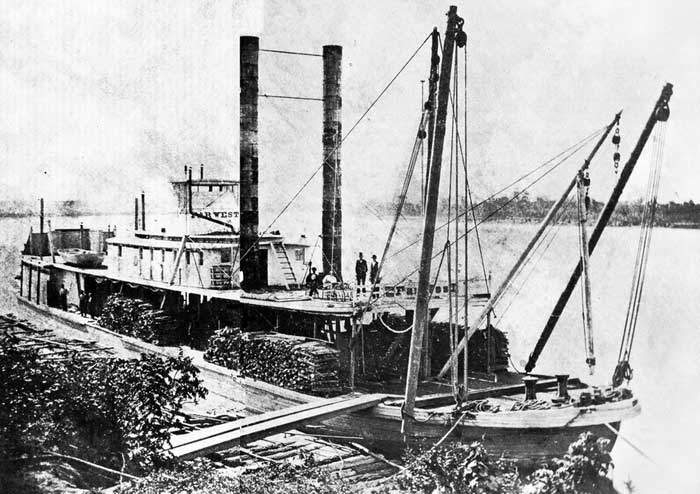
"Back in the old days some of the steamboats were equipped with what were known as 'jack spars' or 'grasshoppers'. It was two long heavy wooden poles with spars and booms rigged up to a harness that was rigged to the steam capstan of the auxiliary steam engine.
These shallow=draft boats could use this rig to hop its way over shallow spots and shoals like walking on crutches. The sternwheeler "Far West" is so equipped."
So they actually set these tall poles on the too shallow bottom and then used a capstan and winches to lift the boat up enough to go forward or backwards(?)
This old picture seems to show the SS Klondike using these grasshopper poles when she got in trouble(?) Parks Canada - S.S. Klondike National Historic Site - Sinking of the S.S. Klondike I
23/04/2013 11:36 pm
The KLONDIKE is stuck alright, but the spars aren't going to help her any with the trouble that she's just seen. She's not stuck on a bar; she's sunk on a bar! Nevertheless you can see that the spars are set as if to get her off of a bar.