
Topic starter
12/11/2006 9:46 pm
As Editor of the Encyclopedia of Northern Kentucky (forthcoming 2008 by University Press of Kentucky), I am interested in knowing when steamboat captains on the Western rivers became licensed officers and not simply the boat's owner or representative.

12/11/2006 11:33 pm
Paul,
The steamboat Act of May, 1852 (signed into law in August of that same year) provided for the examination and licensing of both pilots and engineers by the local inspectors.

13/11/2006 4:09 am
Vic Canfield and I were with Paul when he penned this question. I guess that we should have asked when did boat masters became licensed officers. I believe that it was sometime after the Steamboat Act of 1852 and War of Northern Aggression.
The reason for this question is to gain a bit of insight into Frederick Laidley. Way's Packet Directory reports that he became captain of the packet ANNIE LAURIE during October 1864. To my knowledge Laidley never was a licensed officer, and his later title Commodore was honorary. Did he indeed have a master's license or was this before masters had to have a license?

13/11/2006 11:39 am
Hi, Frank:
Good question on your part Re: Fred Laidley's title 'Commodore.' I've a file here I started on Laidley a few years ago as he has always been a personality of high interest. Tom Schiffer, Don Sanders and I have kicked anecdotes about him around from time to time. Don and I way back talked to Albert Kelley on the DQ and he was the only man I ever met who actually knew and worked for Laidley. Don recalls Kelley's description of Laidley's "billy goat whiskers." What did he look like? One photo I have reminds me slightly...a little...of Fred Mertz on the 'I Love Lucy' TV show--except with the chin whiskers.
Laidley did pen for Ellis Mace's book a short, vague history of his early career and, being the conservative man he was, is pretty cicumspect. About his license I'm not sure but will dig out. He started on the river as a young man and 'may' have been on/around the 1852 date mentioned by Barb Huffman when official licenses came to be required.
The title 'Commodore' as you indicated may be honorary. That was usually reserved for men who were not only licensed masters but owners of their own boats and fleets. Judy Patsch has a great handle on the history of the Streckfus Co. and possibly could relate other titles of 'Commodore' on the Mississippi.
I'm a tad vague until I dig here but think I recall reading old steamboat business papers--and hearing Fred Way talk--that John W. Hubbard had been sniffing around the L. & C. LINE as early as 1912. Hubbard was a dynamic character in his own right and Fred Way penned a letter in 1950 relating a famed court case in Pittsburgh when Hubbard had some disagreement with his son-in-law. An argument develped and the said son-in-law poked Hubbard in the eye. The letter I have was one exchanged between Capts. Fred Way and Fred Hornbrook and they knew the details. You can almost hear the veiled laughter between the two relating it.
Cheers,
R. Dale Flick

13/11/2006 1:20 pm
Frank,
I don't know the answer with regards to Commodore Laidley's license, but for instance, we know Samuel Clemons got his license in 1859, and was apparently required to do so. Maybe licensing was gradually enforced, or some who had already been on the river were grandfathered-in. But that's a guess. There was someone on the old steamboat.org board that could probably tell us everything about it, but can't remember their name..

13/11/2006 1:28 pm
Dale, see Chapter 13 of Steamboats on the Western Rivers, by Louis C. Hunter. On page 544 it states that masters and mates were first required to be licensed in 1871. That is when Captain Thomas P. Leathers asked, "What's the use of being a steamboat captain, if you can't tell everybody to go to H--l?" Note: he did not say, "somebody," or "anybody."
13/11/2006 6:54 pm
Thanks, Alan, that cinches it!
13/11/2006 8:11 pm
So before 1871, was it an elective thing to get a license? Why did Sam Clemons go to the trouble in 1859, if it wasn't required then?
13/11/2006 8:28 pm
Sam Clemons was a St. Louis - New Orleans pilot and not a boat's master. By law he was required to obtain a pilot's license. Before 1871 the boat's master was the owner or a trusted representative of the owner, and no government license was needed.
13/11/2006 8:31 pm
Ah, nevermind.. Sam Clemons was going for his Pilots License in 1859 - which was required by the Steamboat Act of 1852. Captains/Masters & Mates were then required in 1871 and thereafter. So if Paul's original question was strictly about Captain's licenses, then 1871 is the answer. For Pilots the answer is 1852 (with many types of vessels being exempted until 1864).
13/11/2006 8:44 pm
Frank, I already answered my own question (below) as you were posting this...

13/11/2006 10:10 pm
How about engineers? When did licensing begin for them?
14/11/2006 2:25 am
Barbara Huffman posted the answer to that above; licensing engineers was mandated by the Steamboat Act of 1852.
14/11/2006 1:44 pm
Right you are, Frank - boy, I gotta do something about my short-term memory.....
14/11/2006 4:08 pm
Samuel Langhorne Clemens was the real name of Mark Twain. In the discussion about licenses it is interesting to note that the Act of 1852 exempted almost everything except passenger-carrying vessels. After a number of unlicensed and uninspected boats exploded alongside packets it was decided that all boats must be inspected and all officers must be licensed. Actually, inspections and license examinations changed often, starting in 1838 and continuing to today. Each year they become stricter and, often, more absurd.
A continuing discussion in the Waterways Journal is about the elimination of pilots' licenses. All are now classed as masters. Many pilots do not wish to take on the responsibilities of master. Some have retired. The initial examinations have become so costly that few are applying. As a result there is a scarcity of masters and salaries for those who are left have gone sky-high.
Topic starter
14/11/2006 4:27 pm
Thanks to all of you for your professional responses! To those I've only heard about from Frank and Vic and never had the pleasure of meeting in person--Alan, Steve, and Ketih--many thanks. To those I've met and count as old friends--Frank, Barbara, and Dale--likewise many thanks for putting up with my ignorance. With all of your help, we'll get the Ohio River and steamboat entries correct,
Paul
14/11/2006 5:07 pm
Hi, Paul:
Hadn't seen you in a spell but good having you posting on the web. Your initial question gets things on a roll and that's what makes it fun. The joy of Steamboats.org is that one question leads to an exchange of information and even more questions like the classic 'dialogues.' *One error on my part. When I mentioned the 'bio' of 'Commodore' Fred Laidley in the CINCINNATI...1788-1912 source I saw I hit Volume III. I checked and there are only II volumes. It may cause a problem for you or somebody trying to look up information. Yes, there are still a few people around Covington and Cincinnati who have memories of the last of the Laidley family.
Cheers,
R. Dale Flick

14/11/2006 5:22 pm
Frank,
You should talk to your neighbor, Bernie Moorman, who has quite a storehouse of knowledge on the Commodore and the Laidley family.
20/11/2006 1:33 am
LOL..
LOL Alan. I want to get a Master's License!

21/11/2006 4:38 am
This is Annie Blum hoping that I can offer some help. It seems that the crew at Mercantile Library has an ongoing project posting dates and names of officers beginning in the late 1800s. Remember, this is ongoing so that means that it is not finished. The site address is: www.umsl.edu/pott/pguides/pguides.html. www.umsl.edu/pott/pguides/pguides.html
21/11/2006 2:30 pm
Mercantile Library license project
...and the project would get done faster if some of the malingering typists like me would get on the stick! I typed a section of New Orleans 1897 licenses the first go round, and it was interesting to see the names, such as the Leathers family, and others which are still around the area today. One of the licensing categories was "Special Pilot". Bette Gordon didn't know what that covered. Could it have been something similar to the state pilot associations today which handle the ocean-going vessels from the sea buoy to Baton Rouge?
21/11/2006 5:03 pm
Judy, my guess for the "special pilot" category would be for special, difficult sections of the river. Capt. Ray Prichard told me more than once about licenses that excluded the "Des Moines Rapids" or specifically for the LeClaire Canal. There were definitely, according to Capt. Prichard, specific endorsements FOR the Des Moines Rapids or LeClaire Rapids. Was there also a special endorsement for the Falls of the Ohio?
21/11/2006 6:21 pm
The Louisville Falls pilots were a professional organization. The members were licensed for the stretch of river that included the falls. Owners who want to rest easy hired them. I went over the falls a couple of times in the 1950's and I believe there was no endorsement needed.
Excepting to pilots, it was much like the rest of the river, but very swift. To pilots, who knew what they were not seeing, it was scary. It was slow going up and fast going down, but not thrilling. One of my trips lasted about nine hours going up, but mere minutes returning. I hasten to add I have never steered there!

27/11/2006 11:03 pm
Here is actual 1854 Pilot Certificate
for Elijah Chaddick - licensing him for one year for the Ohio and Mississippi Rivers from Louisville to New Orleans and signed off by inspector Joseph Swagar? and Reuben Dawson, dated 02/01/1854. It says "In accordance with the Act of Congress, approved August 30, 1852" right across the top. I attached here (compressed) so not sure if readible or not.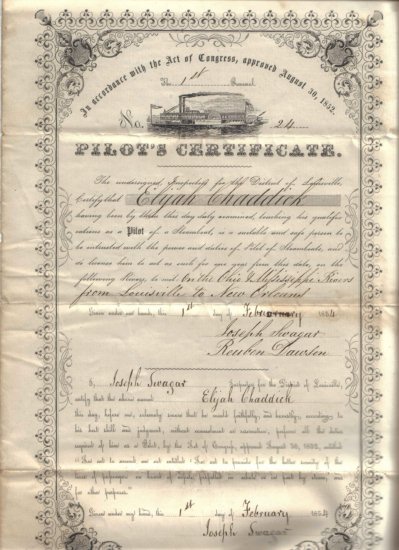

28/11/2006 12:11 am
Including the Falls of the Ohio...
I remember pilot licenses stating, Including (or not) the Falls of the Ohio.. Captain A.J. Schletker may have had the "falls endorsement" on his ticket. Probably a lot of others did, too, but I do not recall specifically which one's did. Harry Hamilton would also be a good bet.
We went over the falls in high water on either the DELTA QUEEN or the AVALON, and the excitement did not quite equal the anticipation. We also went around the Chain-of Rocks, above St. Louis, by-passing the canal, several times. The Falls and the Chain experiences were similar, and though each was not as exciting as a whitewater raft ride, neither were they a bore-- just different from the usual. But I was observing from on-deck and not aiming a steamboat loaded with folks, nor eyeballing the situation from the pilot's perspective.