
Topic starter
12/12/2008 5:16 pm
The attached picture is of the DQs pilothouse in 1955. At the sticks is CApt. Paul Underwood. Note the absence of radar, charplotters, GPS, VHF radio, and river charts. These were all in the pilot's head at that time. As George McBride said about those days "You'd better not have a river chart in sight, you were supposed to know the river you were running". Is the river safer today? I can't think of any accidents these old pilots had. I don't think the DQ had any lost time accidents due to navigational errors back then.

12/12/2008 6:18 pm
Jim , Point Well Taken !
Jim ,
First of all , Thanks so much for posting this picture and your comments and your point was certainly well taken ! I for one believe that the Pilots of today would and could not measure up to the Pilots of yesteryear ! Despite the advent and presence of all of the modern day " gadgets " , they are only
" Aids To Navigation " and nothing will ever replace the earned ability and knowledge of a seasoned Pilot ! Despite the marine industries and Coast Guard's notions and attempts to either down grade and even replace the Pilot , there is just simply no substitute for the presence of an experienced and knowledgeable Pilot ! I certainly cannot speak for the attitudes of the marine industry in other ports and in other countries but I can for the New Orleans and Gulf Coast region . Here , unfortunately , the local marine industry thinks of us and has even told us to our faces , that in essence the local State Pilots are " Over-paid and Glorified Bus Drivers " ! Fortunately , the Ship Masters that we work with on our assignments think otherwise and not only appreciate our service but has testified on our behaf that they would never ever enter the New Prleans-Baton Rouge ports without a Pilot !
Smooth Sailing !
Ted davisson
Jim Reising;14657 wrote: The attached picture is of the DQs pilothouse in 1955. At the sticks is CApt. Paul Underwood. Note the absence of radar, charplotters, GPS, VHF radio, and river charts. These were all in the pilot's head at that time. As George McBride said about those days "You'd better not have a river chart in sight, you were supposed to know the river you were running". Is the river safer today? I can't think of any accidents these old pilots had. I don't think the DQ had any lost time accidents due to navigational errors back then.

12/12/2008 6:20 pm
Jim, your picture is very interesting when put next to a picture of an oil painting being offered on eBay right now...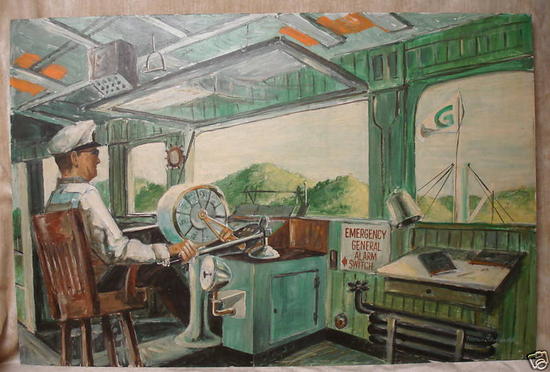

12/12/2008 7:52 pm
Ted, I beg to differ a bit. Today, as in the past, dispatchers and owners load everything they can find on each towboat. The pilots of today may have the bells and whistles of electronic aids, but I have yet to see a chart or electronic system that shows the sets of currents at all stages or the wind direction and strength. I have the same high regard for today's pilots as I have for the "great" ones of the past.
Topic starter
12/12/2008 8:38 pm
There is one big difference between todays pilots and yesterdays and that is HORSEPOWER. Todays pilots in many cases have enough horsepower to get themselves out of trouble. In the old days, when they did not have that advantage, they had to know how NOT to get in trouble in the first place.
Years ago when I was dispatching, we would put 15 loads on the TRADEWINDS which was only 1400 hp. Today they put those same 15 loads (a lock can only hold 15 barges plus the boat) on a boat with 5,000 hp. Which would you rather take through the Louisville harbor with 16 ft. on the upper guage and the dam all out?
I'm not deminishing the talent of todays pilots by any means, I know many I would put up against the best of the old timers. I'm just saying that the pilots of yesterday really had it a lot harder.

12/12/2008 10:10 pm
Did they remove the pilotwheel at Dravo in '47-'48 or some other time? I never picked-up that bit of trivia.
12/12/2008 10:14 pm
Alan , Point Well Taken !
Alan ,
Point well taken , but in my humble opinion , with today's Pilots as compared with yesterday's Pilots , for at least the ones that I have observed , there is still a certain something that is missing . What that SOMETHING is , in all honesty , I have yet to put my finger on . Call IT or the certain SOMETHING , or even THE RIGHT STUFF , what you will , I believe for the most part , today's Pilots , are lacking it . Maybe its just intestinal fortitude or the right attitude or just plain ol' intuition , I believe that the Pilots of old that I witnessed and worked with and was mentored by had an inner self confidence and ability that I see missing today . Just food for thougt .
Smooth Sailing !
Ted Davisson
Alan Bates;14663 wrote: Ted, I beg to differ a bit. Today, as in the past, dispatchers and owners load everything they can find on each towboat. The pilots of today may have the bells and whistles of electronic aids, but I have yet to see a chart or electronic system that shows the sets of currents at all stages or the wind direction and strength. I have the same high regard for today's pilots as I have for the "great" ones of the past.

13/12/2008 2:24 am
15 Jumbos on the Tradewinds? really? at 1400HP? I can't believe they could even shove them. AEP's 2800s have a heck of a time as it is now if the river is running a little bit of water.
13/12/2008 3:47 am
Nick I think you are thinking of the current Timothy Bo Taylor ex.TRADEWIND. I'm sure Jim is referring to the big TRADEWINDS which was a sistership to the SOLVAY and CHARLESTON. In the 1950's that was big horsepower. It was also real honest horsepower and thrust. Slow speed engines turning big wheels, usually in nozzles. Jim's point is very valid as to the pilots ability to just not get in a bad spot. In those days we were bored stiff 90% of the time and scared stiff the other 10%. Trust me!!
Topic starter
13/12/2008 4:56 am
Capt Joe Hughes was in my opinion a real pilot from the old school. At his funeral a few years back his son had one of Joe's chart books on display. My, it was interesting to read the notes Joe made on those charts. One that really struck me was at mile 635...he wrote "large rock on Indiana bank and he drew it in on the chart with the note "when rock is almost under water bad out draft at 44" There were notes like that all through the charts. With knowledge like that he could avoid getting into trouble miles ahead of time.
Harry Hamilton also kept notebooks, but mostly on the lower Miss. Also Harry would turn on the radar on clear days when he was running a bridge or some other obstacle and make a drawing of the radar screen, that way he knew how to shape up for the bridge when he had to run it on radar.
13/12/2008 10:51 am
That oil painting was made by Marion Bradford (Thompson), I'll bet. She rankls with the very best river painters. Her works have an indefinable "life" that is lacking in many paintings. Her works rank with Harlan Hubbard's and John Stobart's. In this one she has perfectly caught the attitude of that pilot.
13/12/2008 11:01 am
Ted, I think the big difference is in memory. Those old-timers were forced to notice and remember. The charts were crude. The electronic tools did not exist. All of it was in a man's head.
As for courage, or guts, in an emergency that remains the same. Either a man stays or he quits.
The most "noticing" man I ever met was Captain Jesse P. Hughes. One morning he told me about a fig plant that grew outside of his bedroom window in Hawaii. His verbal description amounted to a full-color movie. His approach to seeing and learning marks was, no doubt, fully as thorough.
13/12/2008 11:09 am
Captain Harris Underwood kept notebooks and made entries every day, even on the Belle of Louisville's short, dull trips. I never saw him open one to refresh his memory. Writing what he observed seemed to fix it in his mind. He recorded the draft at head and stern every trip, weather, odd happenings, boats met, etc., but he'd recite the information without referring to the little pocket notebooks.

13/12/2008 12:56 pm
I've been blessed to know some fine pilots of today--and they are still drawing on the charts. Obviously, I can't compare them to the pilots of yesteryear, nor can I do the comparison that someone who has a pilot's license has. But I've talked to other pilots, and they talk to me--I think I have a fairly good idea who has the skill today. I've been up in the pilothouse when something very small happens. It's clear to me that that a good pilot reacts immediately, and it never has the chance to become anything else. When nature takes its course, and things break down, I've seen some mighty fine piloting. I am no pilot, but I know enough to know skill when I see it. What a gift my years on the river have been!
13/12/2008 12:59 pm
Capt Bates, the painting is by Warren Stichtenoth and is titled Pilotin' comes Natural, offered right now on eBay at a steep price, but then again it is an original oil. I love the Greeneline pennant...
I have a question about something shown in both the picture and the painting. I see Capt. Underwood's hand on the right stick...just below his hand is what appears to be somekind of joystick thing in a half bullet brass housing, though I seriously doubt it had a "joystick" action...What is it's function?
For anybody interested in the eBay auction, link below:
http://cgi.ebay.com/Warren-Stichtenoth-Oil-Painting-Delta-Queen-Steamboat_W0QQitemZ220327277121QQihZ012QQcategoryZ551QQssPageNameZWDVWQQrdZ1QQcmdZViewItem
13/12/2008 1:32 pm
That is a Carlisle & Finch searchlight directional control. Moving the joystick changes the light's direction: forward the beam goes down; aft the beam goes up; right it goes right; and, believe it or not, left, the beam goes left. There is another style with a horizontal lever. The Belle of Louisville has both kinds. The switch is separate.
13/12/2008 2:32 pm
Oh no, I didn't know what boat Jim was talking about, I figured there were probably several named Tradewind. The Timothy Bo Taylor was named after my uncle who worked on the river. I am pretty sure that boat is 1200HP. I have seen the Charleston go by our riverlot on the Kanawha river all the time. 🙂 Where is the Tradewinds now? is the name different?
13/12/2008 3:24 pm
Nick: In recent years the big Tradewinds was known as the Pretty Paige, running for the Beesecker's out of Paducah. She was sunk in hurricaine Kitrina. Last I heard she was raised and tied off in the NOLA area.
13/12/2008 4:51 pm
I dont reckon anyone uses carbon arc lights anymore do they?

13/12/2008 4:51 pm
Bear in mind that most pilots, if not all, learned what they know from a pilot, or pilots, on the job. This lineage can go all the way back to the hey day of the steamboat.
I have come to the conclusion, though, that before electricity, these guys had great night vision. It wasn't constantly being destroyed by electric lights. Or maybe they had more rods back then and we are evolving to less night vision due to artificial light. But I don't think so. Try it sometime, if you can find a place where there isn't a dang light bulb blazing away.
13/12/2008 4:53 pm
Thanks Capt. for the information...somehow I just never envisioned electric joystick control of anything being available then...
I assume from the compact size of the joystick controller that it is indeed electrical with an electric circuit between the tilt and pan motors at the searchlight and the controller in the pilothouse... not mechanical force like an airplane stick.

13/12/2008 5:25 pm
Mel,
The BELLE OF LOUISVILLE still has 3 carbon Arc units and no modern Halogen or Xenon units.
They are an art to learn to operate and a talent to keep operating...I know, I have played with them many times. Sternwheelers have a natural vibration that can knock them out of alignment really easy. On the BELLE, I have had the pleasure of replacing the carbons, and adjusting them for a Pilot while underway.
~Travis~
13/12/2008 5:32 pm
Steve,
To my knowledge the pilotwheel was removed in 1952-1953 winter at Cincinnati, OH. Any picture you see of the DELTA QUEEN with the single double-wide center window in the Pilothouse was after the wheel was removed, as they had to cut the wheel in half to get it out and they took out the framework between the two windows in the center of the Pilothouse to get the halves out of there.
The wheel was taken aboard the boat in 1981 from Cincinnati (where it was stored by Greene Line and the Delta Queen Steamboat Company) and delivered to Gallipolis, OH where it continued on a truck to the Ohio River Museum, where it is on display today. In 1981 the farthest up the Ohio the DELTA QUEEN ventured was Gallipolis...so that is where they delivered the wheel.
Somewhere I believe I have some pictured the ob-board photographer took of the removal of the wheel in Gallipolis. Back in those days they had a photographer aboard...and Vic Tooker would buy me copies of all the "fun" pictures.
This was the same year she cracked her shaft and the DELTA KING's shaft was built into a new wheel for her. I have at least 5 or more pictures of her with a towboat strapped to her hind quarters and one of the wheel being lifted aboard her at Jeffboat in August of the same year.
~Travis~
13/12/2008 5:43 pm
Hey thanks Travis , I was just curious. Yeah I remember all too well changing carbons in all kinds of weather and having to adjust them too. God I hated that dust!
13/12/2008 5:47 pm
Yeah Travis I was Mate on that trip when she was towed. First by the Caire E. Beatty and then by the Imogene Igert.
Page 1 / 2
Next