
Topic starter
19/07/2008 12:15 am
Reading Capt. Way's book published in 1951 is always a joy and I recently picked it up again. Just the perspective makes it so enjoyable because the vast majority of the ole gal's history had yet to occur when that book came out. Anyhow looking at the photos I come up with some questions...
1. What happened to her wheel? When was it removed infavor of the current hydraulic steering levers? Did she original have steam assisted steering such as that on the Belle with vertical levers and foot brakes slowed or stopped the wheel?
2. What was her rudder arrangement when she entered Green Line service, did she have her original four main rudders? At which point in time did she loose two of her mains for two larger ones and the monkey rudders?
3. When did she get her steam bow thruster installed?
4. Is her current whistle the original whistle to the boat from 1925? Interesting note, in a conversation with Stan Garvey some years ago, the King's original stack still exists, being used as a small tool shed in someone's yard/field in CA, that was as of almost a decade ago, it may no longer exists sadly.
5. Since we're talking about original equipment now...what happened to the lifeboats from the DQ as they were removed over the years? Did any survive and end up in private hands? Any exist today?
Just some little facts I have been wondering it, and thought it could generate some interesting conversation. Please anyone and everyone contribute!
Long live the Delta Queen!
Phillip Johnson

19/07/2008 12:43 am
Hi, Phillip! I will try to answer a few of the questions you posed, but we'll have to wait for others to get some of them!
(1) The pilotwheel was removed sometime in the late 50's, I think. It did have a steam assist and had the vertical levers you mention, similar to the BELLE. Mrs. Letha Greene tells about this in her book "Long Live the DELTA QUEEN!"
(2) Yes, she had her original 4 main rudders up until the new hull was put on late 1980's. The monkey rudders (two rudders aft of the wheel) were added in the late 50's or early 60's, and were in addition to the four original main rudders. The 2 and 2 combo was fitted when the new hull was put on. The boat never had a long stern rake, and after the new hull, it is even bluffer. The boat never backed very well, and that was made worse after the new hull.
(3) The bow thruster is diesel, and was installed in 1971, I believe. I was powered by a GM V-8/71 diesel, and I assume it still is.
(4) Yes, that is the original whistle. Capt. Greene toyed with the idea of replacing it early on (and maybe did it), but the one she blows now and has for the majority of her career is the original, a 3-chime Lunkenheimer.
Hopefully someone else with more info. can chime in and embellish this.
19/07/2008 1:01 am
I've seen pictures, mostly in old Reflectors, of the wheel being carted off. Always wondered how they got it out of the pilothouse, without cutting out walls, it's a big mother, 10 feet in diameter...the pilotwheel was donated to The Sons and Daughters of Pioneer Riverman in September 1980, but it was replaced with hydraulic many years before that. The wheel had been in storage in New Orleans up to then.
The bow thruster is still diesel, and I can hear it and smell it in my head. I love that smell though I'm not fond of the smell of semi's, go figure...
There is also a stern thruster which I believe is electric and rarely used.
Bob, in a truly ignorant question, does "three chime" mean three separate whistles manifolded and operated together? If not, what does three chime mean? I ask 'cause the present DQ whistle is now just one whistle body. Best whistle on the rivers, but I'm a bit biased...
And I'm gonna add a question or five (I'm counting, Judy)...Was it a good luck thing that there was a star on each end of the paddlewheel shaft? And why/who removed them and when? And why does the MQ and AQ have deck stars and the DQ does not?
Same with all the acorns...somebody explained this to me, but I guess I forgot...what was the symbolic significance of all the turned wood acorns. I suspect it was again for luck, but what is the connection, luck to acorns?
19/07/2008 1:16 am
Bruno, I'll answer my part as best I can and leave the rest to others (though I think I know about the acorns, but not sure!).
Yes, the Three chime whistle is divided inside to 3 chambers of different lengths. 3-chime, single-barrel is what I would call it, but am ready to stand corrected. A normal 3-chime whistle would be 3 separate whistle barrels (each one sounding only one note) on a manifold.
And I agree, it is the prettiest whistle there is!
19/07/2008 1:29 am
Bob, thanks...Damn, I love this forum...

19/07/2008 1:42 am
Bob neglected to mention that he was the star painter on the DQ...when he went over to towboats, we spotted his right away - stars on the deck. And acorns: good luck, decorations, and supposedly caught the lightning strikes. Each line had its own acorn color scheme, although red and gold was very popular. The NATCHEZ has been blessed from the beginning with acorns made by Larry Walker of Cincinnati, in his home workshop...pix later
19/07/2008 1:42 am
And I'll add a bit 'cause I can't stop. Phillip, I suspect you're interested in the original steam aspects of the DQ...
True story, about two summers ago the boat lost her house water system, this system supplies all the drinking water, basically all water except toilet flushing water. Anyways, the fancy schmancy Grundfos house water pump decided to go south (a great, high quality pump that Grundfos, spec 'em all the time, but even great stuff breaks over time). Anyways a little head scratching occured until engineering remembered the original steam powered water pump was available for reconnection to any of the boat's water systems...some wrenching later, and away we go...
19/07/2008 1:46 am
and don't forget the steampowered capstan...
19/07/2008 1:58 am
Yeah, Judy, I'll plead guilty to some stars, but Dave Tschiggfrie was first!
Bruno, we old-timers remember when the water in the toilets was river water. It was not flushed overboard in my time, but went to a treatment system; however the supply water was filtered and was the color of the river -- you could tell which river you were on by looking at the water in the commode: muddy for the Mississippi below St. Louis, clearer on the Ohio and the Upper, and clearest of all was the Tennessee!
Topic starter
19/07/2008 2:09 am
Capstan
Ok Judy may have answered a new question that arose. Someone told me long ago the thruster was steam...which was difficult for me to beleive b/c knowing a little about engineering I couldn't imagine the propulsion type..turbine would use so much steam and another steam engine would require more space and crew when it was in use. I always assumed it was diesel but the steam claim did explain the steam always seen blowing out of her hull when landing or departing. Now with the fact the capstan is steam powered is brought to my attention.....is THIS the source of the steam exhaust blowing out of the bow as she is docking? The capstan would be in use at that point. It was nice to see the same capstan still adorned the bow of the King when i visited her, not sure if the bollards are original or recreations. I knew I'd come to the right place!
19/07/2008 2:16 am
Phillip that is exactly what you see from the bow when docking...steam exhaust from the capstan. Makes a pretty neat sound too, much quieter than you'd expect..
19/07/2008 11:50 am
That steam capstan IS a neat piece of equipment. Also steam operated (and exhausting outboard on the port bow) is the stage hoist engine. It has a lever to "put it in gear" so to speak, to ship it up for up or down direction. One of the first things to do when getting ready to operate either the capstan or stage hoist is to crack the steam supply valve a bit, in "neutral", and blow the condensate out of the line -- keeps condensate out of the cylinders which could cause a cracked head.
Another source of steam from hull outlets used to be the steam syphons used for ******* out the bilge water. These were replaced with electric pumps upon installation of the new hull. Once at Cincinnati, there was a photographer taking publicity photos of the boat. There was a syphon blowing steam (all water had been sucked out and the syphon was "blowing"). I was on the bow, and she came down wanting to know if we could "stop that smoke coming from the side of the boat". Needless to say, I became alarmed at the thought of smoke coming out the side of the boat! When I discovered it was a syphon blowing, I explained what it was, and offered to let it blow a little while longer, thinking that would add a "steamy" look to her pics of a steamboat. "That's not the effect I'm looking for" was the reply.
19/07/2008 12:20 pm
I guess Phillip has semi-raised a question that I've always had...What equipment on the Delta Queen still uses steam? I believe I've got a bit of it, thanks to some one on ones with Chief Shenk, though some may be on the wrong list:
Stuff that uses steam and returns the condensate back to the boilers:
1. the paddlewheel engines
2. the fuel oil tank preheats
3. boiler water preheating
4. domestic water heating
5. house/cabin heating
Stuff that uses steam but wastes the condensate, requiring boiler water make up:
1. the capstan
2. the calliope
3. the whistle
4. the fuel oil steam injectors (big source of lost condensate)
5. the boiler blowdowns
6. the boiler soot blowers
From what I have gathered all pumping and all airconditioning is done with electricity now and no cooking is done with steam, correct? But, I gotta believe the lists above are not complete, please embelish.

19/07/2008 2:34 pm
Wildcat and Ed Smith
The capstan engine can also be shipped-up to power the "wildcat", or anchor hoist. Sometime ago, I wrote about the time, in 1970, when the DELTA QUEEN had lost steam and was hanging on the hook just below Memphis with a traveling USCG Inspector aboard from the Commandant’s office in Washington. When steam was raised, again, and we started raising the anchor, the capstan engine ran through itself. Subsequent investigations pointed to the engine room and a lack of proper maintenance on the cute little steam engines. With Chief Cal's approval, the care of greasing and oiling went to YT and my deckhands, and we delighting in indulging that set of capstan engines in special, loving care.
The stage hoist is not original, of course, as the DELTA QUEEN did not carry a stage in its California days. Those twin-cylinder engines came off a steam-powered digger boat, and were used to hoist a clamshell sand bucket. Captain Hawley could probably pin down exactly where the hoist engines originated.
All those engines used huge amounts of steam. Ed Smith, Legendary Steamboat Fireman, would leave the sanctity of his firebox and come out on deck and scold anyone foolish enough to allow too much of his precious vapor to carelessly escape into the atmosphere without doing any useful work. Ed got his start on the Streckfus Steamers and fired on several of those legendary steamboats that Judy often mentions.

19/07/2008 2:46 pm
Just add the aforementioned bilge siphons and stage hoist engine to the second list, at least as part of the past. More on the cursed siphons. Steam siphons are great when they work, but are picky as to what the conditions have to be for them to perform. The siphons on the DQ always seemed to work, but did not have to work against pressure like boiler siphons. Here's my siphon story. Was siphoning a forward bilge when it ran out of water and started to pick up the oil that was floating on top of the water. So we have atomized oil blowing out under pressure and blowing right back on the foredeck. Before I could shut the thing off, deck hands and foredeck was covered with a layer of super slick slick. It was horrible and took a lot of mopping and degreasering to remove and in the meantime the chief engineer came to check on things and went flying when he hit that slick. The rest of us were in a sense ice skating. I kept an eagle eye on those bilges after that.
19/07/2008 3:16 pm
Regarding our toilet water: we sure could tell where we were by its color. I loved departure days from St. Louis - newcomers could be heard flushing and flushing their toilets, thinking they hadn't been flushed yet. Since we were a few miles below the confluence of the muddy Missouri and Mississippi, St. Louis was certainly a 'brown water' town. One other interesting place was Greenville Mississippi. Enroute we of course had brown water from Ol' Miss, but Greenville is on Lake Ferguson, which has clear water. So when we were docked in Greenville, our water was clear. Back on the river, it went back to brown.
19/07/2008 3:16 pm
Oh yeah, Sam, I've had Ed come out and tell me more than once to "Shut that off!!!"
20/07/2008 9:05 pm
Phillip, at least one of the lifeboats seemed to remain with the ol' gal during her early days with Greeneline. I'm assuming it is one of the same boats as the original eight (8) lifeboats, looks the same to me. See below a picture I nicked from an eBay listing, I'm thinking at the latest very early 50's here, someone please correct me if I'm nuts. Notice the very, VERY early Greeneline oval style shorty stack with the G over dark green before they started adding round stack extensions at the top to solve the, ahem, fallout problem.
Also no calliope and the subsequent circus fru-fru, no wingbridges, no wingbridge stairs, lots of funnel ventilators and I'm not sure I'm seeing any searchlights, either... other than the one I think was on the kingpost at the time...lots of windows on the main deck that are now gone, too. And I'll bet dime to donuts the paddlewheel is either black or dark green in this postcard.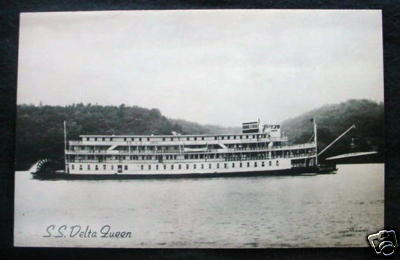
Topic starter
20/07/2008 11:53 pm
So her wheel wasn't always red in GL service? I know it was black in CA when under the cover, but just assumed it was red once the Green's started running her. There's another one Bruno...any of the old stacks get saved? I know a lot of times as things get removed from ships (or boats in our case), crew members would save them for themselves if possible as souviners. Any of her old stacks survive the times?
Interesting note about her original lifeboats, they were supported by Welin brand davits, this is the same company who made the too few for the Titanic and Olympic. Part of one still remains on the Delta King displayed on the main deck in the forward lobby.
It appears as tho the Greene's left space enough for two boats on her in many of the early photos I have seen, yet I have never seen both boats in place, just the forward one. Interesting to look at deck plans and compare the King and Queen to each other today and then to their original layouts.
21/07/2008 12:16 am
Hi, Phillip. We discussed the wheel/splashboard/stack extensively in a thread back in March of this year. Read all about it:
http://www.steamboats.org/forum/steamboats-history/2117-dq-history-continuing-education.html
21/07/2008 12:21 am
Wingbridges, yes
Here are 2 more photos from that Lodder series, Bruno. There are wingbridges but you can't really tell from the angle of the pix you posted. The bridges were accessed by walking out a door in the rear of the pilothouse to the roof and onto the bridges. I believe that stage is from the GCG, but the pix is prior to her retirement in 1952. In the night shot, check out the car on the bow. I'm guessing that might be Mrs. Greene's, as she often rode the first night of a trip and then drove back to Cincinnati. Also, I think I can see the pilotwheel in the night shot, right?

21/07/2008 12:58 am
Here's another one, courtesy of Capt Gabe through Keith Norrington to me. This is Pittsburgh 1958, and I'm 99% sure this was the exact moment I went aboard to visit as a 5 year old, I even remember boarding on the starboard side, assuming she visited Pittsburgh only once in 1958... anyways...Notice how the stack is starting to grow in height. It sorta looks like the oval lower stack is still below it.
John Mullen called me about my earlier photo and this photo shows the same thing or this case lack of something. Where are the outside stairs from the Texas down to the Cabin Deck? And next question, obviously, when were the stairs added.
Phillip, as you walk on the Texas deck you can still see the rounded roof beams where the Cabin deck was either originally notched out to accommodate the lifeboats, the cutout since filled in with deck and handrail, or this rounded beam was the structure to hold the lifeboats in place.
Judy, thanks for the great pics...in your pics the searchlights are obvious, I knew that didn't make sense...other things I find interesting in these pictures: no chain handrails on the stages, windpowered turbine ventilators instead of available powered fans for bathroom exhaust, no air conditioning for the "observation lounge" and other spaces (Orleans?). All is equipment that now clutters the roof. Also no light mast above the pilothouse...
21/07/2008 2:39 am
The chain handrails on the stage appeared in the late '80's or early '90's. I always thought they were silly, as that stage is so wide. All that stuff up on the roof was added piece by piece over the years in response to the desire for better air conditioning, galley ventilation, etc. The crew quarters were originally not air conditioned; that changed in the early 1970's when the crew quarters were rebuilt as semi-private rooms (2 to a room) rather than larger bunkrooms (all deckhands together, all waiters together, etc.) Shipyard Sam can expound on that. The new crew quarters were air conditioned with a chilled water system and individual fan units in the rooms. These worked pretty well except when they were pre-heating the fuel oil (#6 oil) right under where you were.
The Texas Deck to Cabin Deck outside stairs are there; they are recessed within the jutted-out Cabin Deck at the point where it gets wider aft of the Forward Cabin Lounge; the Purser's Office and Gift Shop are under these stairs.
Now I am going to attempt to describe the stack from the early '60's thru about 2000. I wish I had a photo to post showing all this, but I don't: the stack had a jacket that was oval in shape that came up from the Sun Deck roof. At the top of that there was a lip that shed rain water. Above that lip was the stack top, which was also oval in shape, and sat atop the stack base. This top part could be removed, but only accompanied by a lot of work and cussing. To do it involved getting up on a ladder and fishing a small hook into a pad eye inside the stack top. This was done while hot gases were hitting you in the face, and the hook and eye were pretty small. You'd better hope they didn't let her soot up while you were doing it. A small crane was there to raise the stack top high enough to clear the aforementioned lip, and then you could swing the top over and set it on the deck....about a 2 or 3 hour job. The new stack (much as I dislike the looks) is designed to be able to be lowered easily by one person, and if I were still the person responsible for getting it down, I'm sure i would love it.
Topic starter
21/07/2008 2:52 am
Notice between this photo and Judy's photo she lost the center column combining two windows into one larger one on the wheelhouse. I always liked the looks of the smaller windows, waffled paneled walls and aft wings, but as far as functionality goes, the new ones are much better I'm sure. Also for the stack being mentioned, I was on the roof of her in Louisville one time, we were gathering info for a model we were building so we walked the boat with paper and tape measure in hand. One thing they let us do to get the "new" stack dimensions (as it was very new at the time) was drop it down to get a diameter measurement. All it took was a little tug and down it came rather easily, then to put it back up, simply ease the rope and up it goes. They got the counterweights just right on that one!

21/07/2008 5:40 am
Judy,
The stage was built for the DELTA QUEEN and was a mirror image of the one on the GORDON. However, it proved too short and was replaced with the style of stage she carries today. The stage on her now is new, as of 1997.
I noticed for the first time the rigging of the stage mast (Kingpost) is singled on either side. I looked at a few older pics of her and when the stage changed to the style we know now, it appears the extra bracing was added at that time. I have never noticed this feature in other pictures of this era.
The night shot is excellent and you can see the pilot wheel in the pilothouse! Wow!
But where is she landed? Mrs. Greene did ride the first night out alot. Usually that was from Cincinnati. This being the case, one would think Louisville, or Madison, IN. However, the angle of the stage definatley puts those two towns out of the running, for in the ear of this photograph, both had cobblestone grade wharves...and this is definately a concrete esplanade. My guess (and it is totally a guess), based on the lights to the stern of the vessel creating a crescent, is New Orleans (in high water obviously). Any one else have a guess?
~Travis~
Page 1 / 2
Next