
Topic starter
27/01/2013 6:15 am
The Clara Poe
The Clara Poe Chronicle
You may think of Clara Poe as the daughter of Thomas Washington Poe and Phoebe Kinsey born in the little known borough of Georgetown, PA in 1845. My Clara Poe was a trim sternwheel wooden-hulled packet built in California, PA in 1859 (149x32x4’9”) with a measured capacity of 208 tons.
According to the Certificate of Enrollment for the Port of Pittsburgh dated 26 Nov 1859, the str Clara Poe's first master was Capt Thomas W Poe and the original owners and their shared investments are listed in the following table.
Str Clara Poe
Owners and Partners Share Vol: 6642
Jacob Poe 1/4 Enroll No : 182
Thomas Poe 1/8 Cert Date: 26 Nov 1859
Martin L Poe 1/8 Cert Type: Admeasurement 11
George Poe 1/8 Build Locn: California, PA
Jonathan Kinsey 1/8 Build Date: 1859
George W Ebbert 1/8 Master: Thomas Poe
(The sum of the shares is short. Either there was a 1/8 common share or an original owner was not listed. On the second Certificate of Enrollment dated 4 Mar 1861, brother Andrew Poe was listed as an owner with a 1/8 interest in the packet. Ebert was also misspelled.)

Named in honor of his daughter Clarissa J Poe, the str Clara Poe was a typical Poe family packet. These Poe family boats were not the nodding deep water boats of the lower Mississippi River. The Poe brothers believed that moderately sized packets yielded a better return on their investment. Costing less and shallow enough in draft because of their size, Poe boats could run on the upper Ohio and Missouri Rivers when the river level was too low for larger craft to operate. They could make more paying trips per season than owners of larger boats. The Poe brothers also favored the sternwheel design for their packets. This business philosophy made sense and proved its worth by returning good profits over the years.
Thomas W Poe Home ca 1890 (Frances and John Finley Collection)
The str Clara Poe was used in the Pittsburgh to Cincinnati trade until impressed into US service in 1862 according to Fredrick Way’s Packet Directory. Few details of the early commercial work have been uncovered. In those days cabin passage on a packet was luxurious. Cut glass chandeliers in the parlor, oil paintings in every stateroom, gilded mirrors and marble tables, thick carpets, and steaming foods piled high. Life on the rivers was at its best. Neither homes nor hotels of the 1850’s could provide such comfort. Everyone whose life centered on the river was prosperous. Even the crew walked with a swagger jingling their plentiful silver.

The Civil War changed every aspect of the rivers. The Missouri and lower Mississippi Rivers were virtually blockaded by the secessionists. Boats that had carried passengers in luxury were packed with Union troops and supplies. These civilian wooden hull warcraft had no protection other than a few iron plates shielding the pilot house.
Prior to the Civil War, steamboat men from Georgetown were running on the lower Missouri River and other Mississippi tributaries that railroads would not reach for another twenty years. After hostilities commenced, it was soon realized that the rivers would make or break the Union effort in the western theater of the conflict. Troops and their material, food, and supplies were routinely transported by civilian packets contracted and impressed to service. It was not by chance that the Union Army followed the Ohio and Mississippi rivers and their tributaries. These rivers were military highways with the Tennessee and the Cumberland Rivers running for hundreds of miles through the central part of the Confederacy. The immense superiority of the North in gunboats and packets turned the tide against the Confederacy in the west. These floating fortresses could move an army in two or three hours longer distances than the regular army could march in a day. This combination of power with speed could not be matched by the South.
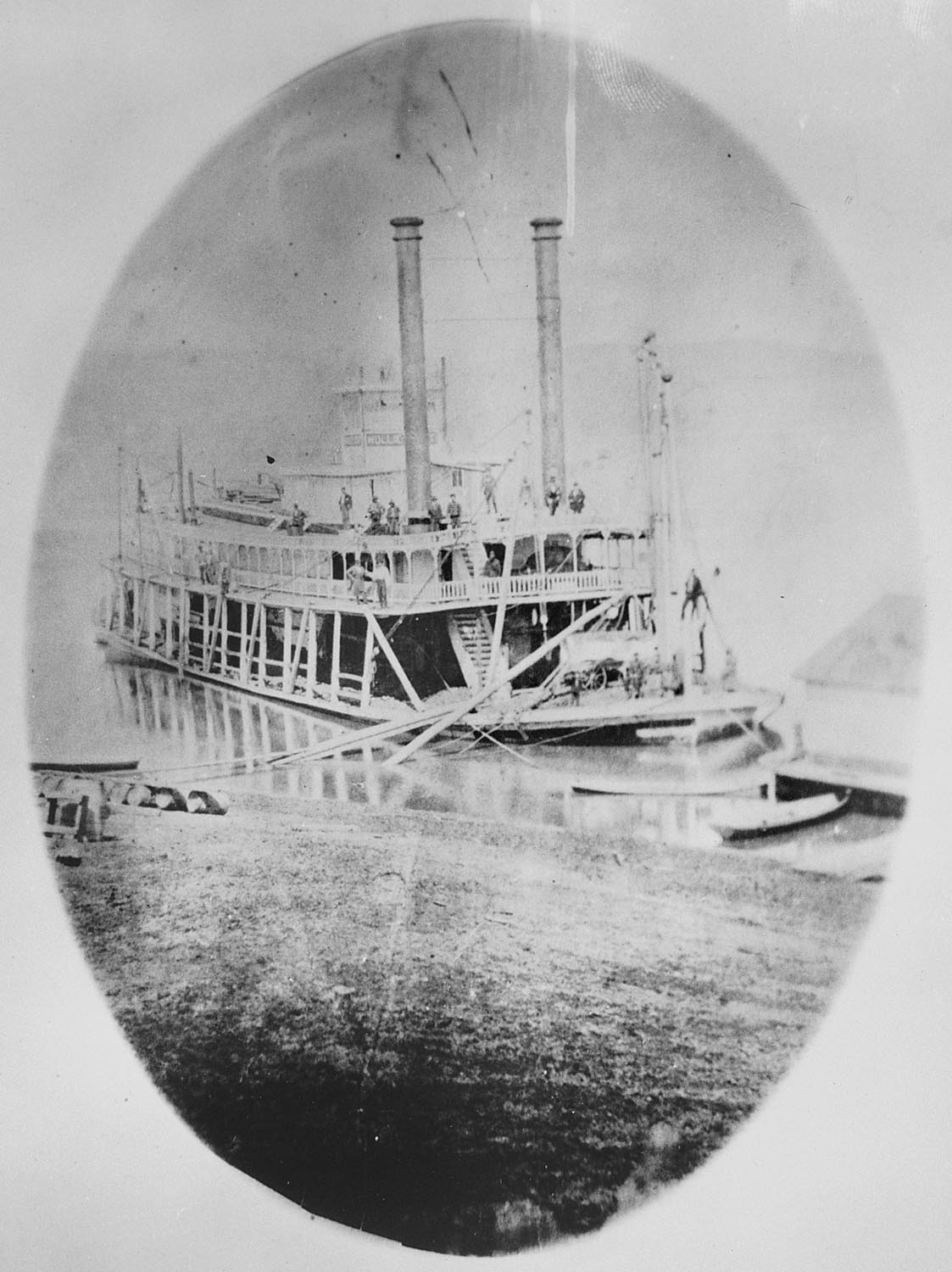
The Civil War service of the str Clara Poe is well documented and began earlier than the date credited by Capt Way. The 78th PA Infantry boarded “on Captain Thomas Poe’s Clara Poe... At 6:00 PM ropes were released, whistles sounded, anchors weighed, and the Clara Poe... sailed quickly from the Monongahela River into the Ohio River enroute to their jump-off point of Louisville, Kentucky, some three days away.”
This sendoff was vividly recorded on Oct 18, 1861. The str Clara Poe was one of six steamboats chartered by Commodore William J Kountz, who had charge of the transportation by river of all troops and Government supplies. The other five packets at the Monongahela Wharf that Oct day were the str Moderator, str Sir William Wallace, str JW Hallman, str Argonaut, and the str Silver Ware. (Near Vicksburg in May 1863, the str Moderator collided at night with the str Horizon which at that time was owned by John N McCurdy (1/3), Thomas S Calhoon (1/3), Richard Calhoon (1/4), and William White (1/12 of Georgetown, PA. The collision was a Civil War tragedy where many soldier lives were lost.)
In Mar-Apr 1862, the str Clara Poe was a member of Grant's fleet on the expedition to Pittsburg Landing in support of the battle at Shiloh. Whether the str Clara Poe was chartered or impressed to service is unclear. Some Civil War historians contend that Shiloh was the turning point of the war.
On May 13, 1863 the str Clara Poe transported the 14th Illinois infantry from Memphis to Vicksburg. Some Civil War historians contend that Vicksburg was the turning point of the war. Whether Shiloh or Vicksburg was the critical battle, the str Clara Poe was at the center of it all.
As either a troop or supply transport, 13 Jun 1863 found the Clara Poe steaming near Island No 76 on the Mississippi River while employed by the Quartermaster.
On 18 Jun 1863, Lt-Com James M Prichett at the mouth of the White River sent a report to Admiral Porter concerning two steamers:
"Last night after the fleet came down to Island 76 and the steamer New National had taken charge of the Clara Poe and hay barges. I steamed down river toward my station…" .
There are no details of next three chartered assignments. The str Clara Poe was chartered from 24 Jun 1863 for an unknown period, from 4 Dec 1863 to 4 Jan 1864, and again from 8 Jul to 15 Aug 1864.
An article in the New York Times on Aug 15, 1864 reported:
“On Saturday noon of the last week the str Clara Poe, bound for the Tennessee River with two heavy barges loaded with government stores, having on her own deck a load of fat cattle was attacked by a rebel force estimated at 700. The rebel commander Johnson ordered the str Clara Poe to bring to, and upon her Captain refusing to comply. a fire of musketry was poured upon her.”
The article goes on to state that the str Clara Poe had been pierced with approximately 500 musket bullets. In great detail the escape is described – discarding the barges, running the cattle off the deck into the river, etc. A good read.
The last documented charter for the str Clara Poe extended from 30 Dec 1864 to 22 Jan 1865. The str Clara Poe was one of sixteen packets in the fleet that transported Gen McLeans division down the Tennessee River so that the troops could be repositioned east. The str Clara Poe arrived at Paducah on 18 Jan 1865.
In Jan 1865, the str Clara Poe was one of a fifty-two (52) steamboat fleet employed by the Army Quartermaster to move Schofield’s XXIII Corp from Paducah, KY up the Ohio River to Parkersburg, WV where they transferred to the B&O Railroad to complete their trip to Annapolis, MD.
Capt Jacob Poe partner in the Clara Poe (Anna L and John F Nash Collection)

The str Clara Poe met a fiery end on 17 Apr 1865 at Eddyville on the Cumberland River while transporting supplies and barges of hay to Nashville. (If the date seems curious, it is because the war in the west continued for about thirty days after Lee surrendered to Grant at Appomattox Court House on Palm Sunday 1865.) The owners of the str Clara Poe formally requested indemnity from the US Army Quartermaster. Correspondence between the principal owners and the US government is available at the National Archives in the military “Vessel File”. In an undated signed letter with the request, Jacob Poe explained the conditions at the time of the “calamitous event”.
Jacob Poe Letter to US Army Quartermaster undated (Courtesy of the National Archives)

“She was in 15 ours run of
Nashville it was a very
dangers load to carry but she
was set on fire by 2 hands that
was shipped at Louisville, Ky
and they jumped in the river and
swam a shore and neve was
seen afterwards
Steamer Clara Poe
was burnt April 17, 1865
Capt Jacob Poe”
Written in the margin of this note was request to the Dept of War to conduct and investigation signed Chas C Townsend.
Years later, Jacob Poe responded to some non-archived correspondence by Chas C Townsend dated 16 May 1890 with a letter written on his son’s livery letterhead dated May the 18 1890.
Jacob Poe Ltr 18 May 1890 (Courtesy of the National Archives)

Honorable
C.C. Townsend
your letter may 16 reed
I was not on the gun boats
I was on the transporty boats
carring soldiers and forage
during the entire war
would like to know if there is
eney chance to get pay for the
steamer Clara Poe which was
burnt when she was forced to take
a load of hay for the government
to Nashville for I think the
government will not want us to
loos the boat and the expenses
of taken the load as near the
destination and loos the boat
and expenses it cost two thousand
dollars expenses to whare she was burnt
The next correspondence was dated 10 Jun 1890, or maybe 16 Jun 1890 — some twenty-five years and a few days after the actual “calamitous event”. By that date the principal owner and first master of the Clara Poe, Thomas W Poe had been dead nine years; George W Ebert had been gone eleven years; George Poe six years; Andrew Poe 3 years; and the status of Jonathan Kinsey is unknown. Quite possibly, Jacob Poe was the only living owner of the str Clara Poe. And Jacob Poe died less than a year later on 13 Mar 1891. The battle for compensation was waged through six presidencies, Andrew Johnson to Grover Cleveland, without success.
In correspondence of dated 10 Jun 1890, addressed to Jacob Poe, and signed by Chas C Townsend, the Deputy Quartermaster General, the twenty-five year on indemnity debate ended. After a paragraph of introduction Chas C Townsend stated that:
“you are respectfully informed that this vessel was not chartered by the government at the time — having been discharged from such service on January 22, 1865. She is therefore not found on any government report subsequent to that date and although she may have been engaged as a common carrier transporting public property the vessel cannot be considered to have been in charge of the US government at the time of her destruction.”
With that pronouncement, the str Clara Poe was a complete loss to her owners including her expenses on her fatal last trip up the Cumberland River. Chas C Townsend, Deputy US Army Quartermaster, had no record of charter so he rightly, or wrongly, refused to compensate the owners for their loss. The Gibsons’s dictionary does not note the destruction of the str Clara Poe which indicates that no charter agreement had been signed, recorded, and archived. In Way’s Dictionary, Capt Way states “she was still in US service when she burned near Eddyville on the Cumberland River” although Capt Way’s words included no citation.
Natural connections of the actions of the str Clara Poe sketch a portrait of a boat and crew that had patriotically worked the entire war on the western rivers. Contrary to Chas C Townsend’s penchant for accounting detail, the probability that Thomas W Poe was doing government business was high. I believe that the government records were misfiled, lost, or intentionally ignored by the deputy quartermaster. The only other plausible explanation was that Thomas W Poe was coerced, or compelled by a sense of duty, to transport the supplies without proper authorization and orders. The Poe brothers were Federal Union men. Their loyalties were deeply felt.
Earlier a precedent had been set for direct action without compensation when Capt Thomas W Poe was cited by the mayor of Pittsburgh for volunteering to go to the Cumberland River to relieve sick and wounded soldiers.
Pittsburgh, PA,
Feb 19th, 1862
I desire that the captains of the following
steamers be placed on record for the patriotic
and liberal (volunteering) of their services
and boats, without renumeration, to proceed
immediately to the Cumberland River to relieve
the sick and wounded soldiers: Rocket, Capt
Wolf; Clara Poe, Capt Poe, Horizon, Capt
Stockdale; Emma, Capt Maratta; Westmorland,
Capt Evans; Sir William Wallace, Capt Hugh
Campbell.
B. C. Sawyer, Jr., Mayor.
This letter, published in the S&D Reflector in Dec 1969, was written by the mayor of Pittsburgh to recognize six steamboat captains and their vessels for their service to the country. My search for the original letter has failed to date. To whom the letter was addressed is unknown. Apparently, working for no salary was not uncommon especially when pressed to service.
The mayor's letter was also interesting from the packet owners point of view. Three of the applauded boats were destroyed during the war. While running at night without lights, the str Horizon collided with the str Moderator near Vicksburg on 1 May 1863. In Jan 1865, the str Emma collided with the Louisville ferry. Both vessels were disabled and both floated helplessly over the falls. A dramatic and tragic ending for the str Emma. The str Clara Poe, bound for Nashville with supplies, went up in flames - burned by rebels on 17 Apr 1865 along the Cumberland River. That date may appear curious. Hostilities in the west continued for about thirty days after the surrender at Appomattox Court House.
All six recognized boats were built and manned from the Pittsburgh region. The str Clara Poe and the str Horizon were owned and operated by steamboat men from Georgetown, PA. The owners of the str Clara Poe and the str Horizon were not compensated for their losses. In the end, the Poe family boat was a loss of between twelve ($12K) and twenty ($20K) thousand dollars. Today, that sum would be approximately $150,000 and $260,000.
According to Capt Way, Capt Thomas W Poe was the master of the str Clara Poe during its Civil War service. Jonathon Kinsey, a neighbor and partner from Georgetown, was one of his pilots. A military officer would have been the commander issuing general orders, but as pilot Capt Poe would have had operational control of the boat. To date, I have not discovered evidence that any of the steamboating Poes received any recognition for their service during the Civil War. Nor have I learned of any compensation – neither pensions nor dollars for the loss of their packets. When the str Clara Poe was contracted by William J Kountz, I assume Capt Poe received a Quartermaster dictated salary of a captain or pilot.
Whether the str Clara Poe was under temporary impressment or charter by the Union Army Quartermasters is at times unclear. It is clear that, whether impressed or contracted, the subject of military transport by civilian crews generated legal problems in the fields of discipline, pay, handling of prisoners, and eligibility for pensions. There was discernable friction between the military and civilian regulatory agencies. In 1862 Col Lewis B Parsons, in charge of military transportation on western rivers, issued an order that
“if anywhere on the Mississippi...if a pilot demanded wages exceeding $200 a month, he was to immediately have his license revoked.”
At that time, the formal issuance and revocation of pilot’s licenses was controlled by the Steamboat-Inspection Service established by the Steamboat Act of Aug 30, 1852. Pilots were the princes of the river. Without pilots, a packet was useless. Not all captains were qualified pilots, and not all pilots aspired to be captains. Even when serving a captain who himself was a qualified pilot, the pilot at the wheel reigned supreme during his allotted watch. This civilian order of control was in conflict with the military chain of command. Both the pilots and the Steamboat–Inspection Service lost power. Under Army control, the civilians working on the transport packets - pilots, clerks, stewards, deckhands - were subject to military discipline and, if captured, were subject to the same treatment extended to members of the army and navy. However, under the Military Pension Act of 1862, the only civilians recognized were those who served on gunboats and other war vessels owned by the Army Quartermaster.
All in all, a river steamer in the western theater with its civilian crew impressed to service during the Civil War was not a good business proposition. These hardy steamboat men took the hard knocks but without the glory.
Gleaming with romance, the American inland river steamboat is one of our most colorful and valuable heritages. The light draft vessel was the technological wonder of its day providing access to the western territories decades before the arrival of the railroads. That many Americans continue to be fascinated by the historical exploits and romantic spirit of steamboats is completely understandable. However, no captain or pilot from Georgetown, PA earned much renown either during his lifetime or the years after his death. During the Civil War, they like many other steamboat men sacrificed, suffered, and learned to live with their losses. The history of the str Clara Poe has been essentially silent despite service to the Union that spanned 3 1/2 years ― beginning on 18 Oct 1861 amid jubilation at the Monongahela Wharf in Pittsburgh and ending in flames on 17 Apr 1865 near Eddyville on the Cumberland River. It is my hope that this account of the story of the str Clara Poe will inform and entertain especially during the Civil War Sesquicentennial. It is a bit of American history too important to be left untold.
References.
1. Frederick Way, Jr.,Way’s Packet Directory, 1848-1994, (Ohio University Press, Athens 1994), p. 99.
2. Frederick Way, Jr.,Way’s Packet Directory, 1848-1994, (Ohio University Press, Athens 1994), p. 99.
3. Arthur B Fox, Pittsburgh during the Civil War, 1860-1865, p 31-32.
4. Charles Dana Gibson and E Kay Gibson, Dictionary of Transports and Combatant Vessels Steam and Sail Employed by the Uniion Army 1861 – 1868, (Ensign Press, Cambridge, MA 1995), p 63.
5. Internet Complete History of the 46th Illinois Veteran
6. Charles Dana Gibson and E Kay Gibson, Dictionary of Transports and Combatant Vessels Steam and Sail Employed by the Uniion Army 1861 – 1868, (Ensign Press, Cambridge, MA 1995), p 189.
7. JK Folmer I, California PA., 1849-1881:The History of a Boat Building Town, (Yohogania Press, California, PA 2009), p125.
8. Charles Dana Gibson and E Kay Gibson, Dictionary of Transports and Combatant Vessels Steam and Sail Employed by the Uniion Army 1861 – 1868, (Ensign Press, Cambridge, MA 1995), p 189.
New York Times Aug 15, 1864.
9. JK Folmer I, California PA., 1849-1881:The History of a Boat Building Town, (Yohogania Press, California, PA 2009), p125.
10. Charles Dana Gibson and E Kay Gibson, Dictionary of Transports and Combatant Vessels Steam and Sail Employed by the Uniion Army 1861 – 1868, (Ensign Press, Cambridge, MA 1995), p 189.
11. Frederick Way, Jr.,Way’s Packet Directory, 1848-1994, (Ohio University Press, Athens 1994), p. 99
12. Charles Dana Gibson, MilitaryTtransport, Civilian Crews, During the Civil War,(Periodical Vol XVI, No 1,Apr 1989), pg 3-20.
13. Ibid.
Topic starter
30/03/2013 5:22 pm
Capt Thomas Poe Misfortune
If there is a “night shade” hovering over any stone in the Georgetown Cemetery, it would be the spirit of Capt Thomas Washington Poe for good reason. Capt Thomas Poe was arguably the most far-famed and ill-fated steamboat captain from Georgetown, PA. Thomas Washington Poe Jr was born in 1819 in New Lisbon, Columbiana Co, OH. He died on 31 Dec 1881 aboard the str Fearless on his way to Pittsburgh.
Misfortune paid its respects to Capt Thomas Poe many times and often far from home. On 11 May 1855 the str Georgetown was fatally snagged at Bellefontaine Bluffs on the Missouri in route to a military post. The str Georgetown was owned by Thomas W Poe and other partners from Georgetown, PA.. He was the principal owner of the str Clara Poe which was burned during the Civil War by rebel forces on 17 Apr 1865 at Eddyville on the Cumberland River. He also owned the str Amelia Poe which was a complete loss when snagged on the upper Missouri river on 24 May 1868 and salvaged by 1,500 riotous Indians. And he was the owner of the str Nick Wall which met a tragic end on the Mississippi River near Napoleon, AK on 18 Dec 1870. Here a grisly incident occurred that Mark Twain retold in “Life on the Mississippi”. Though injured himself by the falling roof, Capt Thomas W Poe attempted to save his wife trapped in a stateroom. He chopped a hole in the roof with an ax striking the unfortunate Martha Jane Poe in the head. Martha Jane Poe, fatally wounded, was returned to Georgetown for burial.
Although he died on 31 Dec 1881 aboard the str Fearless on his way to Pittsburgh, his spirit lived on ― in the courts. The steamer sank eight months later on 26 Aug 1882 on the Missouri. The legal case regarding the property loss was finally decided by the Supreme Court of Missouri in Oct 1887― not in favor of the Poe heirs. That verdict feels perfectly appropriate.
Topic starter
17/04/2013 2:47 am
The First Steamboat War
In May 1846, the US Army was completely unprepared for the logistics problems presented by the Mexican War. Difficult though the procurement of supplies were, the distribution of those supplies presented far more complex problems. Supply lines were longer than ever experienced in US military history. For the Army of the West, nearly 900 miles of Indian Territory separated the Ft Leavenworth depot from Santa Fe and 1,050 miles separated Santa Fe from San Diego. For the Army of the East, San Antonio was 600 miles from Chihuahua and 160 miles from Port Lavacca on the Gulf of Mexico.
Beginning in Nov 1846, the US Army Quartermaster successfully used steamboats for transporting troops and supplies to Ft Leavenworth on the Missouri River and New Orleans. Some of the inland river steamboats also "sailed" the 600 miles from New Orleans over open seas so that they could operate on the Rio Grande during the war. (Sailing vessels also moved troops and supplies from New York and other Atlantic ports to the Gulf. At that time, the steam powered toy called a railroad appeared destined for nothing more than carrying goods to the superior steamboat ports.)
According to the entry in Capt Way's Directory, the str New England was the flagship of a fleet of steamboats departing Pittsburgh with soldiers bound for the Mexican War. In Mar 1847, the str New England was purchased by Capt George W Ebert who operated the sidewheeler between Pittsburgh and Wheeling till 1849. I do not know whether Capt Ebert participated in the Mexican War effort.
The following table lists the owners of the str New England according to the Certificate of Enrollment records dated 3 Mar 1847.
Str New England
Owners/Partners . Vol: 6629
Geo W Ebert . Enroll No : 26
Jacob Poe . Cert Date: 3 Mar 1847
Andrew Poe . Cert Type: Enrollment 180
Thomas Poe . Build Locn: Pittsburgh, PA
Wm J Kountz . Build Date: 1844
David Wilkins . Master: GW Ebert
Check out the owners of the str New England in 1847. All these names spell history. Geo W Ebert was my great great grandfather; Jacob, Andrew, and Thomas Poe were brothers and my great great granduncles. During the Civil War, William J Kountz was the admiral in charge of river transportation. He declared that Gen US Grant was a “glorious drunk” who should be court marshaled. Grant arrested William J Kountz for insubordination.
References.
Topic starter
07/08/2013 5:59 pm
George Washington Ebert
George Washington Ebert was my great great grandfather. He was born 13 Aug 1814 and died in Georgetown, PA on 24 Apr 1879. Those were the years of great experiences and many great men. During his lifetime, my grandfather established quite a record as a wide-ranging steamboat captain and owner. According to the Certificates of Enrollment for vessels more than 20 tons registered at the Port of Pittsburgh, GW Ebert was the principle owner of fifteen (15) packets and was a partner in eight (8) other boats owned by Georgetown men. My definition of "principle owner" is the person first named on the Certificate of Enrollment record for registration of the vessel. And I have not yet concluded my review of the Certificates of Enrollment for the Port of Pittsburgh. No doubt some data is missing due to water damage of early volumes and even worse because of lost or misplaced volumes. Even with incomplete data, the fragments pieced together paint an impressive picture.
I include GW Ebert in the Poe family because he married Nancy Ann Poe the sister of famed steamboat captains Adam Poe, Jacob Poe and Thomas W Poe.
Ebert SteamersDate: 24 Mar 2013
Packet Name Build Date Way's Directory Original Primary Owner (Signed Cert of Enrollment)
Belfast 1843 George W Ebert
Bridgewater 1843 George W Ebert
New England 1844 George W Ebert
Hudson 1846 George W Ebert
Hibernia* 1847 George W Ebert
Glaucus 1849 George W Ebert
Washington City 1852 George W Ebert
Yorktown 1853 George W Ebert
Clifton 1855 George W Ebert
Belmont 1856 George W Ebert
Melnotte 1856 George W Ebert
Argyle 1859 George W Ebert
Kenton 1860 George W Ebert
Yorktown * 1864 George W Ebert
Mollie Ebert 1869 George W Ebert
Fairmont 1837 Jacob Poe
Financier 1845 Adam Poe
Pioneer 1846 Adam Poe
Euphrates 1847 Joseph MC Calhoon
Tuscarora 1848 Jacob Poe
Golden Gate 1852 Joseph MC Calhoon
Caledonia * 1854 Richard Calhoon
Grand Turk 1854 AB Galatin
Topic starter
18/03/2015 3:57 pm
Steamboat Footage from 1929
The video shows a parade of steamboats on the Ohio celebrating the opening of the nine foot channel between Pittsburgh and Cairo. Mrs Howard of Howard Shipbuilding Co strikes a bell aboard the str Cincinatti to open the waterway.
The Odd, Mysterious & Fascinating History of Pittsburgh
This is an incredible website.
Topic starter
11/10/2015 8:20 pm
The Decline of the Pittsburgh and Cincinnati Packet Line.
I posted a brief explanation of the decline of the Pit and Cin Packet Line. Based on an old volume published in 1931 A History of Transportation in the Ohio Valley by Charles Henry Ambler. What makes this volume special are the comments and corrections in the margin written by Harriet Darrington (Calhoon) Ewing, the daughter of Capt Thomas S Calhoon who was VP of the Pit and Cin Packet Line.
Let me know what you think.
Fran Nash

12/10/2015 12:20 am
Excellent article
Thanks for linking this article. Very clear explanation of the demise - and a great picture!

12/10/2015 12:43 am
Indeed it is excellent, Francis! May I have permission to link your article to the S&D REFLECTOR's website?
12/10/2015 1:54 am
Bob Reynolds;35010 wrote: Indeed it is excellent, Francis! May I have permission to link your article to the S&D REFLECTOR's website?
Yes Bob, it will be an honor to have it show in the S&D REFLECTOR. Thank you.
Francis "FRANK" GRIMM
12/10/2015 2:04 am
Wrong Francis. Sorry about that.
Topic starter
22/12/2016 11:03 pm
Capt John Smith McMilllin
Over the weekend, David McMillin introduced me to his triple great grandfather David Bruce McMillin who was born in Georgetown, PA on 28 Jan 1810. The McMillins owned Lots 52 and 53 on the town square. Lot 7 on the river next to Capt Andrew Parr was listed to Steel McMillin, a steamer engineer. A daughter, Sarah McMillin, married George Nash who owned property and a sawmill along Smith or Nash Run.
The email exchange that peaked my interest was the statement that John Smith McMillin was a steamboat captain who owned the str Silver Wave. I had read about the str Silver Wave, but had no idea of its connection to Georgetown. Capt John S McMillin also invented the steam powered capstan. Apparently, he was awarded a patent, but litigation regarding that patent was ultimately decided by the Supreme Court against McMillin.
The str Silver Wave was the first non-gunboat to pass the batteries at Vicksburg. So, Georgetown had two captains with their steamers loaded with troops and supplies at Vicksburg. The str Horizon owned by Captains John N McNurdy and Thomas S Calhoon, collided with the str Moderator on its second pass by the batteries. The str Horizon sunk with a loss of many lives.
In the coming days, I will be adding a bio of Capt John S McMillin, researching the capstan patent, and amending the pages to include him and his steamers histories with other captains from Georgetown. Till then a bio included in the history of A history of the Grace Church Parish transcribed or contributed by Joan Skinnell Benincasa follows. A fun read.
CAPT. JOHN SMITH MCMILLIN.
John Smith McMillin, son of William and Catherine Smith McMillin, Scotch-Irish Covenanters, who settled in Beaver County at the close of the last century, was born July 23, 1817, in Georgetown, Beaver County, Pa., where he spent his youth and received a common school education. He was the fourth child of a family of thirteen children. When fifteen years old he engaged in keel-boating on the Ohio River; he next became a pilot on a steamboat, and soon, by quickness and attention to business, he became a captain and was master and owner of several fine boats, and ran regularly to Memphis, New Orleans and all points on the Lower Mississippi River. During the Civil War he won for himself high reputation for bravery by fearlessly running the blockade at Vicksburg in his boat, the Silver Wave, and carrying supplies to the army below the city.
He invented and put into successful use the well-known steam capstan, now a necessary part of the equipment of every river steamboat.
In April, 1853, he moved to Pittsburgh and built a home on Grandview avenue, corner of Bigham street, Mount Washington, where he continued to reside until his death.
He was married twice. His first wife was Phebe Ann Fry, daughter of Dr. Thomas Fry, of Rhode Island, who moved with his family to Georgetown. They were married in Georgetown in December, 1846, and Mrs. McMillin died in Pittsburgh July 8, 1866, leaving no children. His second wife, Mary Bindley, eldest daughter of John C. and Elmina Bindley, of Pittsburgh, he married August 7, 1867. She and three children, one daughter and two sons, survive him. He was baptized by Dr. Killikelly, in Grace Church, July 10, 1866, at the funeral of his first wife, beside the remains, and was confirmed by Bishop Kerfoot in St. Peter's Church, Pittsburgh, April 14, 1867. He was a vestryman of Grace Church nearly thirty years ; was several times senior warden ; six years treasurer of the church, and was frequently deputy of the same church to the Annual Convention of the Diocese of Pittsburgh. He was a liberal contributor to the expense of putting a basement schoolroom under the church in 1865, and also to the fund for finishing and furnishing the church in 1869. He was a contributor to the support of the church from the time he moved to Mount Washington and a communicant of the same for twenty-six years. He died March 11, 1893, in the seventy-sixth year of his age.
The circumstances of his death were peculiar. On Saturday morning, March 11, 1893, he started as usual for his place of business in the city, the Bindley Hardware Company. Near his gate he met Miss Elizabeth Kenah, and they walked on together, the Captain being, as he often was, in a joking, playful mood. They were proceeding along Grandview avenue going toward the Monongahela Incline Plane, and had just crossed Stanwix street, when he threw his left hand up to his head with an exclamation of sudden pain, tottered, and laid hold of the fence at the side of the street, sank down to the ground and in a few moments (before a physician could reach him) was dead.
The funeral service was held at his late residence on Tuesday, March 14, 1893, at 2 P. M., in the presence of a large gathering of his relations and friends, and he was buried the same afternoon in Allegheny Cemetery.
He was a well-known man, of strong character, noted for his simplicity, honesty and sincerity.
The Rev. R. J. Coster, in an address at his funeral, said:
"God's providences sometimes touch our hearts with peculiar force and stir our feelings to their lowest depths. Their suddenness and their pathetic surroundings point to God's immediate presence and tell us that they are the work of His Hand. We cannot read the secret counsels of the Almighty; but this we know, His ways are wise and merciful. He doeth all things well. His infinite wisdom precludes mistakes. In faith, therefore, we bow to His Blessed Will, believing that His ordering is best. In times of sudden bereavement, like this, the promises of God's Holy Word come to give us resignation and comfort. The Church of Christ, the mother of all the believing, comes to us with her sacred ministrations; her lessons and her prayers speak to us in Christ's name and bid us fear not, faint not.
"These thoughts harmonize well with the occasion that brings us together here today. Our friend and fellow-servant of God, to whom His Master granted more than his three-score years and ten, has been suddenly taken from our midst. So unexpected was the summons that we can hardly yet realize that we shall no more meet him in his home; no more meet him in the church. We have been so long accustomed to see his tall form and his striking features, so long accustomed to see his kindly smile and to hear cordial welcome, that we shall sadly miss him many days. We had learned to look upon him almost as a permanent part of this community. For forty years he had occupied this home and identified himself with the interests of this section of the city. Most or all of those years he has been closely connected with Grace Church. For nearly thirty years he was one of its vestrymen; he was several times senior warden, for many years treasurer, and frequently he represented his parish in the Diocesan Convention All these years he and his family have been members of Grace Church, and often have they come to its aid in times of need. Some of you have known our departed friend longer than I have, but for nearly twenty-five years I have enjoyed his friendship and confidence.
His home was always open to me, and here I always met a kindly greeting and a
cordial welcome. I constantly met him on terms of closest intimacy, and this intimacy only increased my confidence and respect for the man. As one learned to know him well, and to understand his ways and modes of expression, one could not fail to appreciate the sterling traits of his character, his simplicity, his honesty, his sincerity. Like every man of strong character, he had his peculiarities, and these peculiarities caused him sometimes to be misunderstood by those who imperfectly knew him. But to his intimate friends these peculiarities only intensified his personality and made him the man that they love to honor and remember. His sudden departure while still busy with his ordinary duties, the tragic termination of his active life, will tend to prolong his memory and to deepen the keenness of our sense of loss. But let us not sorrow for him as men without hope. He was a believer in Christ. He was a communicant of the Church. He died in the faith; and although he was reserved in the expression of his religious convictions, as most men of a like character are, yet he accepted the great truths of the Gospel and died trusting in his Lord. We can, therefore, lay him to rest believing that God will deal mercifully with him for Christ's sake and give him the rest and peace that shall be the portion of his faithful people."
Burials.
July 10. 1866:
PHEBE ANN McMILLIN, aged 50 years, wife of Capt. John S. McMillin, of Grandview avenue and Bigham street. Service at the church, conducted by Dr. Killikelly, the rector, assisted by the Rev. Dr. Page and the Rev. Mr. Snively, of the city. Buried in Allegheny Cemetery. "A devout communicant of Grace Church, a most excellent Christian woman and a valuable member of the church and of society."
March 14, 1893:
JOHN SMITH McMILLIN, aged 76 years. Service at the late residence of the deceased, Grandview avenue and Bigham street, and interment in Allegheny Cemetery, the Rev. R. J. Coster, his pastor and friend for twenty-five years, officiating. A strong character, noted for his simplicity and integrity. (See obituary.)
Page 2 / 2
Prev